In the last few months several fund houses have launched a new offering known as Income Plus Arbitrage Fund of Fund.
What exactly are these funds?
Should you consider adding these funds in your portfolio?
Let’s find out…
What are Income Plus Arbitrage Fund of Funds?
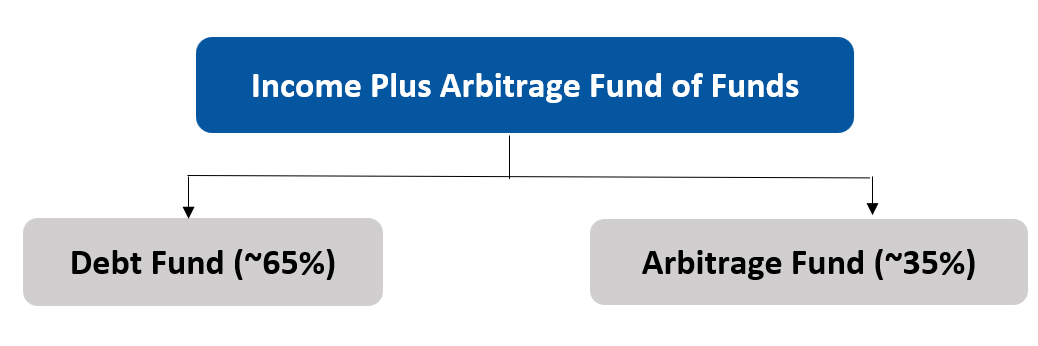
Income Plus Arbitrage Fund of Fund is a combination of Debt Fund (~65%) and Arbitrage Fund (~35%). The objective is to deliver better post tax returns than short-term debt funds but with relatively lower volatility when compared to pure equity funds. To know more about how arbitrage funds work click here to read our blog.
So, what is the big deal about this category?
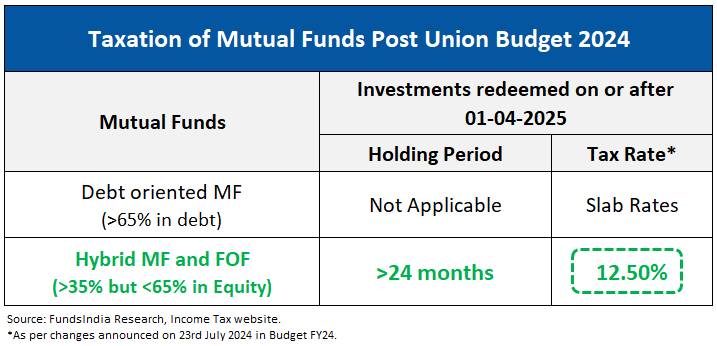
These funds are taxed like equity and hence can be a tax efficient alternative (with lower taxation) over 2+ years compared to FDs.
What are the returns expectations?
If your time frame is less than 2 years, the returns can be similar to short-term debt funds because ~65% of the underlying investments are in Debt Funds.
However, when you hold these funds for a 2+ year time frame then these can provide much better post-tax returns than short-term debt funds and traditional FDs (benefit of equity taxation).
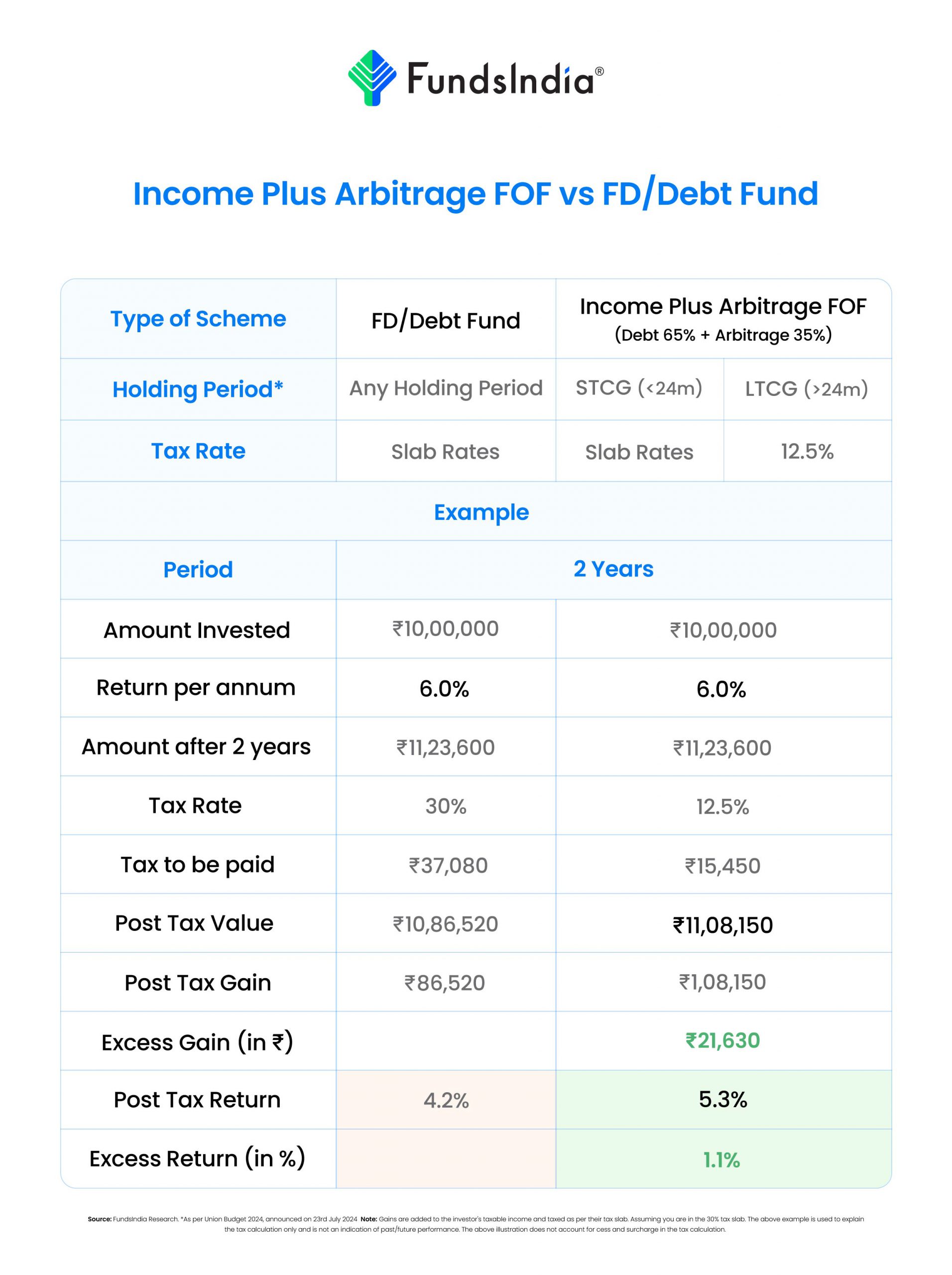
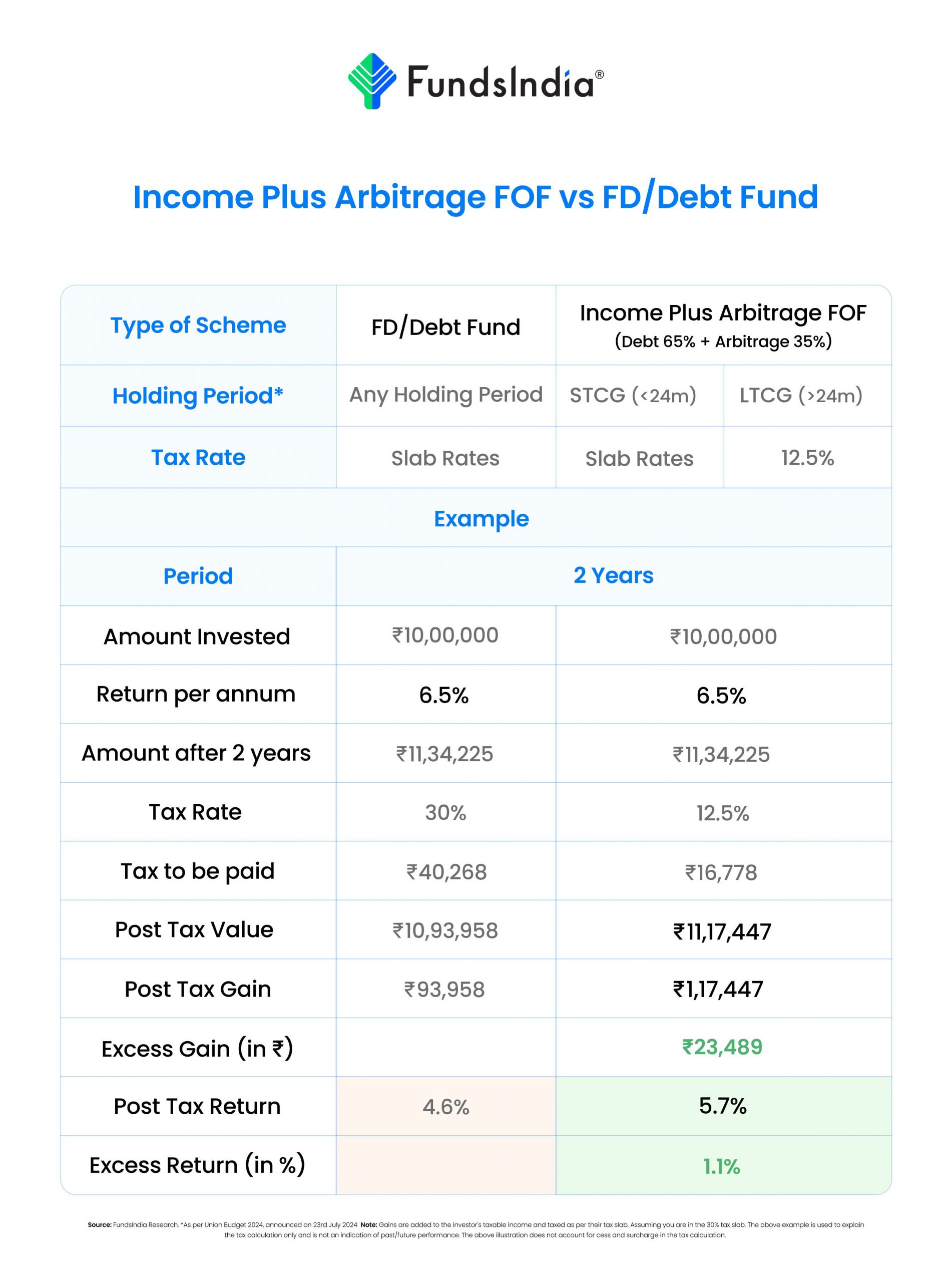
To understand the same we have provided two scenarios in the table below, 1) returns at 6% per annum 2) returns at 6.50% per annum.
For an investment of Rs.10 lakh in Income Plus Arbitrage FOF at 6% per annum,
- Post-Tax Value of investment is Rs 11.08 lakh vs Rs 10.86 lakh from short-term debt fund/FD → potential gain of Rs 0.22 lakh (~Rs 22,000)
- Post-Tax Return is 5.3% vs 4.2% from short-term debt funds/FDs → potential gain of 1.1%
For an investment of Rs.10 lakh in Income Plus Arbitrage FOF at 6.5% per annum,
- Post-Tax Value of investment is Rs 11.17 lakh vs Rs 10.93 lakh from short-term debt fund/FD → potential gain of Rs 0.24 lakh (~Rs 24,000)
- Post-Tax Return is 5.7% vs 4.6% from short-term debt funds/FDs → potential gain of 1.1%
Are Income Plus Arbitrage Funds right for you?
Income Plus Arbitrage FOF can be considered if
- You have a time frame of >2 years
- You are looking for better post tax returns than debt funds and traditional FDs
- You are okay with slightly higher volatility
What are the factors to consider when selecting a fund?
- Underlying Debt Fund Strategy & Track Record – understand the duration profile, credit quality, and type of debt funds used. We prefer underlying investments in short-term debt funds with high credit quality (100% AAA & equivalent) and modified duration of 1-4 years.
- Arbitrage Fund Strategy & Track Record – these funds provide flexibility to fund managers as they can dynamically adjust between arbitrage and fixed income based on market conditions. We prefer underlying investments in arbitrage funds that have a good track record in capturing arbitrage opportunities with comfortable AUM.
- Cost – when comparing the expense ratio of a FOF it is important to look at the total cost,
Total cost = FOF expense ratio + underlying fund expense ratio
Example, FOF Total Cost (Regular) = 1.0% (0.6% FOF expense ratio + 0.4% underlying fund expense ratio)
- Fund house Track Record – we prefer fund houses that have a solid track record of navigating interest rate cycles, managing credit risk across cycles with zero credit events in the past indicating robust credit risk management.
Summing it up
- Income Plus Arbitrage FOF is a new offering in the category of Debt Funds which is positioned as a combination of Debt Fund (~65%) and Arbitrage Fund (~35%).
- These funds are a tax-efficient alternative, benefiting from equity taxation, and tend to deliver better post-tax returns than short-term debt funds or traditional FDs over a 2+ year horizon. The post-tax advantage can be around 1% higher compared to short-term debt funds and FDs.
- These funds can be right for you if you have a 2+ year time frame, looking for better post tax returns than debt funds and traditional FDs and are okay with slightly higher volatility.
- The factors to consider when selecting the fund are underlying debt fund strategy & track record, underlying arbitrage fund strategy & track record, total cost of the FOF and the track record of the fund house.