Company Overview
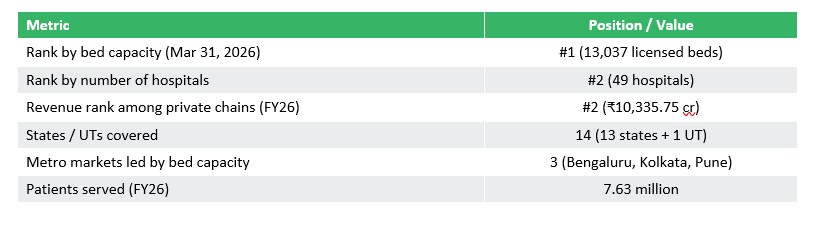
Manipal Health Enterprises Limited is a pan-India multispecialty hospital operator, running 49 hospitals with 13,037 licensed beds across 14 states and union territories as of March 31, 2026. Its network is concentrated in three key regions — Karnataka, Maharashtra and Goa, and select states of eastern India (West Bengal, Odisha, Jharkhand and Sikkim) — and spans the metros of Bengaluru, Kolkata and Pune alongside a wide non-metro presence, with the bed base split 46.78% metro and 53.22% non-metro.
The Company served 7.63 million patients across its network in Fiscal 2026 and had 11,064 doctors and 24,240 employees as of March 31, 2026. Its clinical services are focused on tertiary and quaternary care across cardiac sciences, oncology, neurosciences, gastro sciences, orthopedics and renal sciences, which contributed 64.30% of gross inpatient revenue in Fiscal 2026, and 41 of its 49 hospitals were NABH-accredited. Growth has come through a mix of organic expansion and strategic acquisitions — including AMRI (2023), Medica Synergie (2024) and the Sahyadri Group (October 2025) — with the network expanding from 33 hospitals and 9,520 licensed beds as of March 31, 2024 to 49 hospitals and 13,037 licensed beds as of March 31, 2026.
Offer Summary
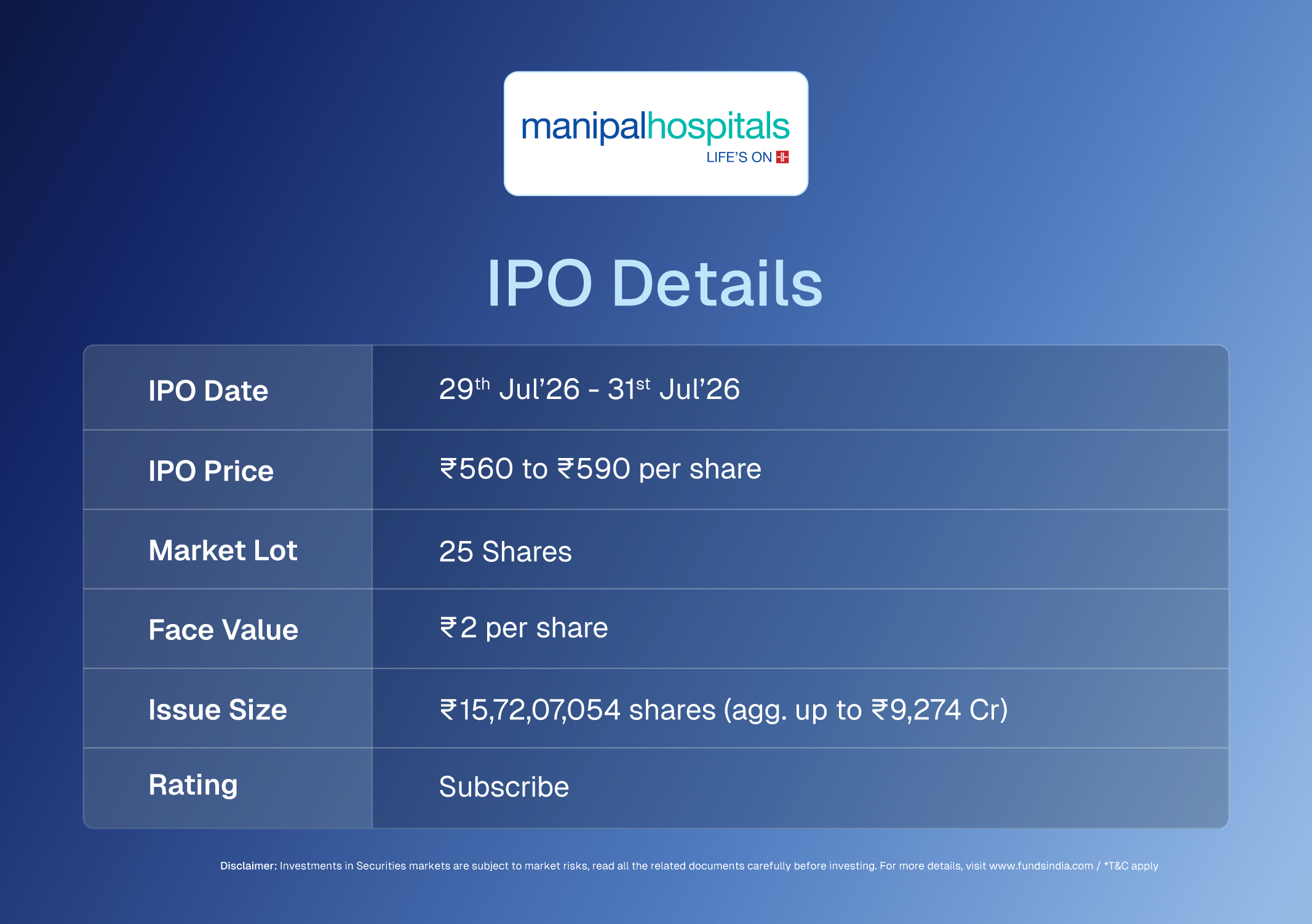
The Company is undertaking a book-built issue at a price band of ₹560 to ₹590 per Equity Share, comprising a Fresh Issue of 13,55,93,220 shares, aggregating up to ₹8,000.00 crore and an Offer for Sale of up to 21,613,834 Equity Shares of face value of ₹2 each by the Selling Shareholders aggregating up to ₹1,275.22 crore.
Objects of the Offer
- Repayment or prepayment, in full or in part, of certain outstanding borrowings and accrued interest thereon availed by the Company’s Material Subsidiary, Manipal Hospitals Private Limited. (₹5,552.76 crore from the Net Proceeds of the Fresh Issue, representing approximately 47.47% of the Company’s total consolidated outstanding borrowings as at May 31, 2026)
- Acquisition of a minority stake in the Company’s stepdown Subsidiary, Sahyadri Hospitals Private Limited — ₹574.00 crore; and
- General corporate purposes (not exceeding 25% of the gross proceeds of the Fresh Issue).
Industry Snapshot
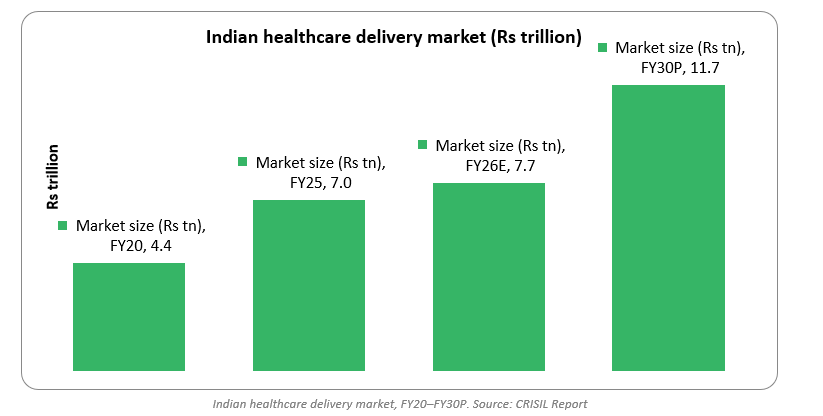
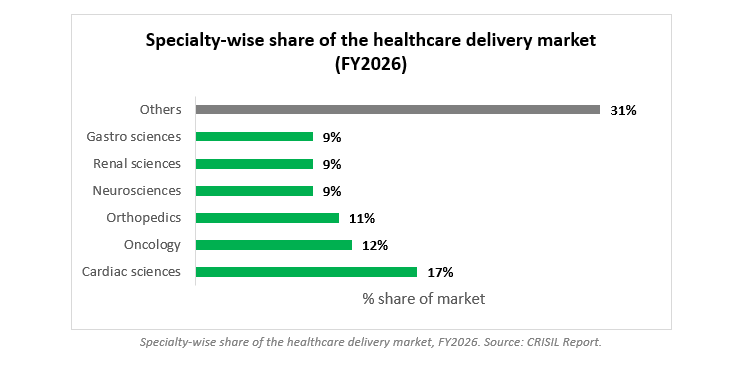
The Company operates in the Indian healthcare delivery market, which comprises In-patient Department (“IPD”) and Out-patient Department (“OPD”) services provided by both government and private players, with IPD contributing the bulk of industry revenue. According to the CRISIL Report, the market was valued at approximately ₹7.0 trillion in Fiscal 2025 and is estimated to have reached ₹7.6–7.8 trillion in Fiscal 2026, with the IPD segment accounting for 71–72% of value. The market is projected to grow at a CAGR of 10–12% between Fiscal 2025 and Fiscal 2030 to reach ₹11.2–12.2 trillion, with IPD growing faster at 10.5–12.5% and OPD at 8–10%. The market remains highly fragmented, with large private hospitals accounting for only about 20% of the overall market in Fiscal 2026, and the private sector’s share of treatments by value is expected to rise from 64% in Fiscal 2020 to approximately 69% by Fiscal 2030. Cardiac sciences (17%) and oncology (12%) are the largest single-specialty segments.
Key structural growth drivers for the industry include:
- Rising chronic-disease burden and ageing demographics: the share of India’s population aged 60 and above is projected to rise from 10.5% in CY2023 to 12.6% by CY2030, and the 40–59 cohort from 22.1% to 24.4%, while the incidence of non-communicable diseases is expected to keep rising through Fiscal 2030 — lifting demand for tertiary, quaternary and geriatric care.
- Rising incomes, health awareness and insurance coverage: growing disposable incomes (the share of households in the ₹150,000–200,000 annual income bracket rose to 40% in Fiscal 2024), improving health awareness, and health-insurance penetration of 41% in Fiscal 2024 alongside a steady decline in out-of-pocket expenditure as a share of current health expenditure, are together widening affordability and access to quality care.
- Structural shift toward private providers, aided by government initiatives: India’s bed density of about 16 hospital beds per 10,000 people in Fiscal 2025 remains well below the global average of 33, underscoring the expansion runway, while schemes such as PMJAY and the Ayushman Bharat Digital Mission (ABDM), coupled with overburdened public infrastructure, are expected to channel an increasing share of demand to private players.
Investment Rationale
India’s largest hospital network by bed capacity with entrenched regional and metro leadership
Manipal ranks #1 among private hospital chains by bed capacity and #2 by number of hospitals, and reported the second-highest revenue from operations in Fiscal 2026. It has the widest hospital footprint of any private chain, holds the leading position in each of its three key regions, and is the only private chain to lead by bed capacity across three metros — advantages built on scale, density and referral reach that are capital-intensive and difficult to replicate.
Diversified across high-acuity specialties, geographies and payors
Revenue is spread across a broad specialty base while anchored in complex, high-value care: CONGO-R specialties (cardiac sciences, oncology, neurosciences, gastro sciences, orthopedics and renal sciences) contributed 64.30% of gross inpatient revenue in Fiscal 2026, with no single specialty dominating. The network is balanced across metros (46.78% of licensed beds) and non-metros (53.22%), the latter offering higher-growth, under-penetrated catchments. The payor mix is also diversified — TPA/insurance 49.68%, cash 30.33%, government 13.80% and others 6.19% of gross inpatient revenue in Fiscal 2026 — which, alongside disciplined working-capital management, supported a negative working-capital cycle of 13 days in Fiscal 2026. In practice, this spread insulates revenue from any single specialty, city or payor shock, while the CONGO-R skew keeps the mix anchored to the most profitable, fastest-growing procedures.
Proven, repeatable acquisition-and-integration playbook driving sector-leading growth
Between March 31, 2021 and March 31, 2026, Manipal was the leading consolidator among private hospital chains by beds added through acquisitions (5,548 beds), and it has a track record of upgrading acquired assets by deepening high-acuity services and instituting disciplined operating practices. This is visible in the margin uplift achieved post-acquisition, illustrated below, and underpinned the company’s industry-leading revenue growth over Fiscal 2024–Fiscal 2026.

Financial Performance
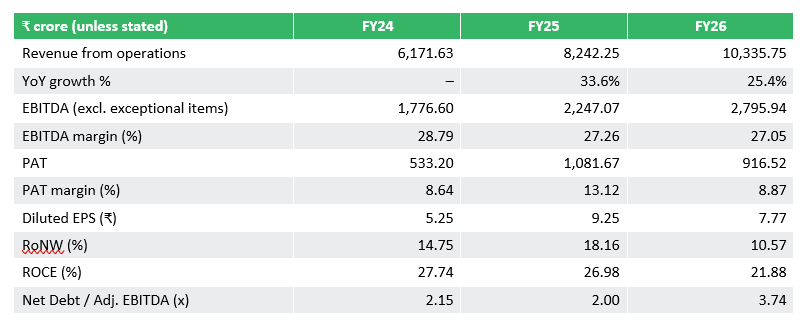
Revenue from operations grew at a CAGR of 29.41% over Fiscal 2024–Fiscal 2026 to ₹10,335.75 crore, and EBITDA (excluding exceptional items) at a CAGR of 25.45% to ₹2,795.94 crore. Profit after tax, however, declined to ₹916.52 crore in Fiscal 2026 from ₹1,081.67 crore in Fiscal 2025: Fiscal 2025 had benefited from an unusually low tax charge (including a ~₹130 crore deferred-tax credit), while Fiscal 2026 absorbed a ~69% rise in finance costs (to ₹864.29 crore) and higher depreciation from debt-funded acquisitions, an exceptional loss, and a normalised tax rate — compressing PAT margin to 8.87% and RoNW to 10.57%. The ₹5,552.76 crore of debt repayment planned from Fresh Issue proceeds is expected to materially lower finance costs and support a recovery in returns.
Key Risks
- Offer for Sale component and use of Fresh Issue proceeds
At the price band, the Offer for Sale of up to 21,613,834 Equity Shares (~₹1,275 crore at the Cap, roughly 14% of the total Offer) represents a partial monetisation by promoter-group and investor selling shareholders, and the Company receives no proceeds from it. Of the ₹8,000 crore Fresh Issue, about ₹6,127 crore (~77%) is earmarked for debt repayment and the acquisition of a minority stake in Sahyadri, so the primary capital funding incremental growth is limited relative to the headline issue size. - Elevated leverage and finance costs
Net Debt (including lease liabilities) to Adjusted EBITDA rose to 3.74x in Fiscal 2026 from 2.00x in Fiscal 2025, and total consolidated borrowings stood at ₹11,185.02 crore as at May 31, 2026, reflecting debt-funded acquisitions (notably the Sahyadri Group). Finance costs jumped ~69% year-on-year to ₹864.29 crore in Fiscal 2026 which — together with higher depreciation and a normalised tax rate — pushed profit after tax down and compressed RoNW to 10.57%. The planned ₹5,552.76 crore of debt repayment from Fresh Issue proceeds should ease this, but until deployed, leverage and interest costs continue to weigh on earnings. - Acquisition-led growth with integration and goodwill risk
A large share of the expansion from 33 hospitals and 9,520 beds (March 31, 2024) to 49 hospitals and 13,037 beds (March 31, 2026) has come through acquisitions, and goodwill on the balance sheet rose to ₹8,120.57 crore as at March 31, 2026. Realising the targeted margin uplift and integration benefits at recently acquired hospitals (as achieved historically with Columbia Asia) is not assured; delays, underperformance, or any impairment of goodwill could affect returns.
Outlook
Manipal is positioned to grow alongside a structurally expanding Indian hospital market, underpinned by its #1 bed-capacity scale, entrenched regional and metro leadership, a high-acuity CONGO-R focus, and a proven acquisition-and-integration playbook, with post-issue deleveraging providing a further earnings lever. Near-term watch items include elevated leverage and finance costs, the margin and RoNW compression seen in Fiscal 2026 from acquisition-related costs, and execution and integration of recent acquisitions, notably the Sahyadri Group. The longer-term case rests on rising healthcare penetration, the ongoing shift toward private providers, and the company’s ability to convert its scale and acquisition pipeline into higher-margin, higher-return growth.
Valuation & View

According to the RHP, the company’s listed peers are Apollo Hospitals Enterprise, Fortis Healthcare and Max Healthcare Institute. The peer group is trading at an average P/E of 70.31x, with the highest being 74.55x and the lowest being 66.15x. At the upper price band, the listing (post-issue) market capitalisation of Manipal will be approximately ₹77,606 crore, and the company is demanding a P/E of ~76x on Fiscal 2026 diluted EPS of ₹7.77 (Pre-issue). When compared to its peers, the issue appears fully valued, sitting at a premium to the peer average. This premium reflects the company’s scale leadership and industry-leading growth, but is set against a modest Fiscal 2026 RoNW of 10.57% and a year in which profit after tax declined; the case for the premium therefore rests on post-issue deleveraging and sustained high-acuity growth rather than on current returns. Based on the above views, we assign a Subscribe rating to the IPO.

Disclaimer: Investments in the securities market are subject to market risks, read all related documents carefully before investing. Securities quoted here are exemplary, not recommendatory. Please consult your financial advisor before investing. Please note that we do not guarantee any assured returns for the securities quoted here.
Research disclaimer: Investment in the securities market is subject to market risks. Read all the related documents carefully before investing. Registration granted by SEBI, and certification from NISM in no way guarantee the performance of the intermediary or provide any assurance of returns to investors.
For more details, please read the disclaimer.