Company Overview
National Stock Exchange of India Limited (“NSE”) is India’s largest stock exchange and a vertically integrated market infrastructure institution, running trading, clearing, settlement, listing, market data and index services on a single platform. Incorporated in 1992 and headquartered in Mumbai, it has been the country’s largest exchange by turnover in the cash market and in equity derivatives since Fiscal 2001, and was the world’s largest multi-asset exchange in Fiscal 2026 by contracts traded in equity derivatives, with a 51.18% global share. As on June 30, 2026 it supported 132.37 million Unique Registered Investors, 1,328 trading members and 3,005 listed entities.
The revenue model is a toll on market activity. Transaction charges — a fee on every trade — contributed 78.65% of revenue from operations in Fiscal 2026, of which equity options alone accounted for 60.2%. The remainder comes from annuity-like streams: listing fees, colocation racks and data feeds sold to brokers, Nifty index licensing, and clearing. Subsidiaries include NSE Clearing (India’s largest clearing corporation) and NSE Indices, whose Nifty family is tracked by 72.59% of Indian passive AUM. The company has no identifiable promoter and no shareholder holds 15% or more of voting rights.
Offer Summary
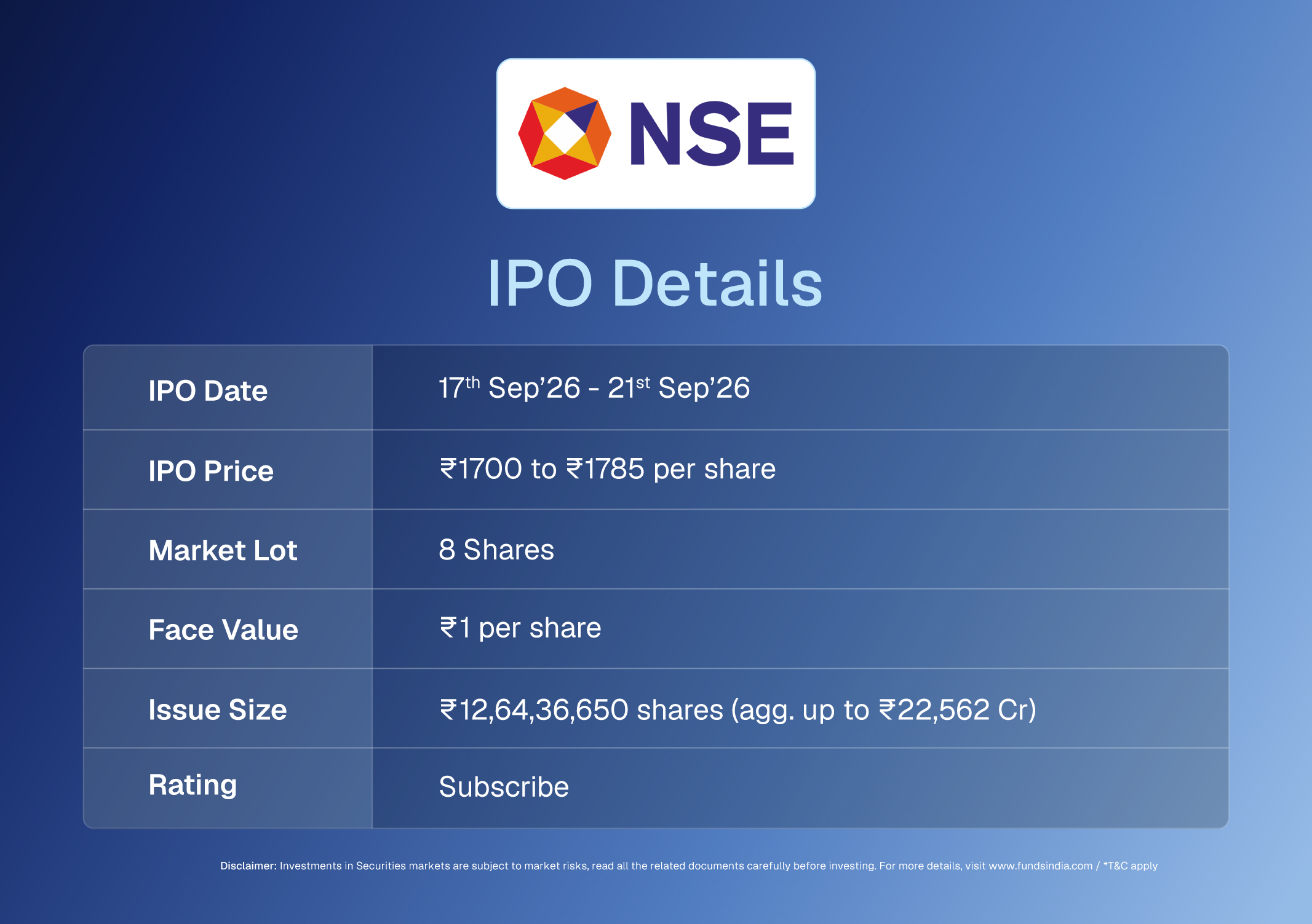
The company is undertaking a book-built issue at a price band of ₹1,700 to ₹1,785 per Equity Share of face value ₹1, comprising an Offer for Sale of up to 126,436,650 Equity Shares aggregating up to ₹22,562 crore at the Cap Price. There is no Fresh Issue component, and the Offer represents approximately 5.11% of post-Offer equity. The sellers are ten corporate shareholders, led by State Bank of India, CPPIB, Aranda Investments (Mauritius), MS Strategic (Mauritius) and New India Assurance.
Objects of the Offer
- Carrying out the Offer for Sale of up to 126,436,650 Equity Shares by the Selling Shareholders; and
- Achieving the benefits of listing on BSE — the shares list on BSE because an exchange cannot list on itself.
The Offer is entirely secondary, so the company receives no proceeds and no fresh capital enters the business, however it carries no meaningful borrowings, generated ₹23,836 crore of operating cash flow in Fiscal 2026 and held treasury investments of ₹68,198 crore at June 30, 2026, making the primary object going public.
Industry Snapshot
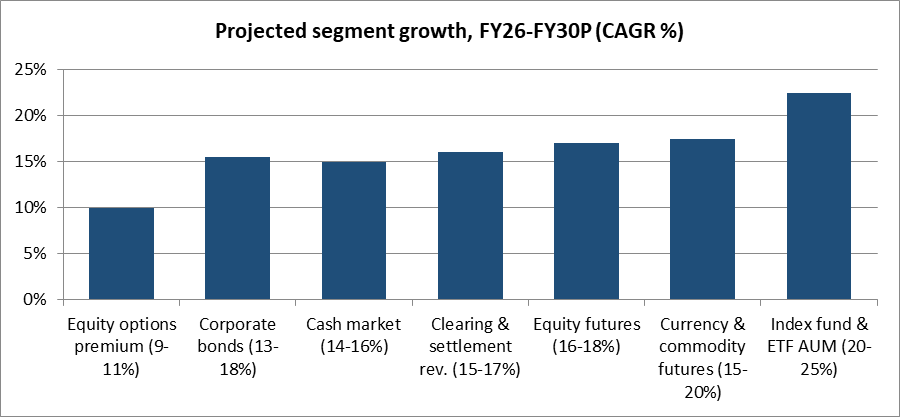
According to the Redseer Report commissioned by the company, every segment NSE operates in is projected to grow between Fiscal 2026 and Fiscal 2030P, but at materially different rates. Cash market turnover is projected to rise from ₹280.26 trillion to ₹473–507 trillion (14–16% CAGR) and equity futures turnover from ₹394.67 trillion to ₹715–765 trillion (16–18%), while equity options premium turnover — the segment that generates roughly 60% of NSE’s revenue — grows slowest at 9–11%. The fastest-growing lines are index and ETF assets and colocation capacity, both at 20–25%, which today contribute a small share of revenue. The industry outlook therefore supports a case built on mix shift as much as on volume.
Key structural growth drivers include:
- Financialisation of household savings — demat accounts have compounded at 32.4% over five years and monthly SIP flows have more than tripled since Fiscal 2021, widening the retail base that supplies order flow;
- Sustained capital formation — ₹20.33 trillion of funds were mobilised on NSE in Fiscal 2026, and the exchange has ranked among the top three globally by number of IPOs since Fiscal 2023; and
- The shift to passive investing — Nifty-linked passive AUM of ₹8.95 trillion represents 72.59% of Indian passive assets, giving NSE a recurring licensing claim on the fastest-growing part of asset management.
Investment Rationale
Near-monopoly positions built on liquidity, not preference
NSE held 93.05% of cash market turnover, 99.72% of equity futures turnover and 100% of currency options in the June 2026 quarter. These shares rest on a self-reinforcing loop rather than customer loyalty — orders route to the deepest order book, and depth attracts further flow, which is why a challenger cannot buy share with pricing alone. Vertical integration compounds the advantage: because trading, clearing and settlement sit under one roof, margin posted in one segment offsets exposure in another, lowering the capital a broker needs to trade on NSE.
Asset-light economics with sector-leading margins and returns
Adding a product or a participant costs the exchange very little, producing rare economies of scale— Normalised Operating EBITDA margin has held between 76.2% and 77.7% across Fiscals 2024–2026, and RoCE was 42.8% in Fiscal 2026 even after a year in which revenue fell. NSE reported the highest adjusted operating EBITDA margin among leading listed global exchange groups in Fiscal 2026, and total income has compounded at 20.51% since Fiscal 2022, placing it among the top three of those groups. The RHP is explicit that these global operators are a benchmarking set, not comparable peers — BSE remains NSE’s only listed peer for valuation purposes.
Recovery already visible in the June 2026 quarter
The June 2026 quarter is the first clean read on the business after SEBI’s October 2024 derivative curbs. Revenue rose 13.1% year-on-year to ₹4,560 crore and profit after tax 6.7% to ₹3,120 crore, with cash market daily turnover up 25.3% and Operating EBITDA margin improving to 78.81%. Trailing twelve-month EPS of ₹42.42 is already above the Fiscal 2026 figure of ₹41.62 — on current evidence, Fiscal 2026 reads as a one-year regulatory reset rather than the onset of decline.
Pricing that sits below recent institutional entry levels
Between January and June 2026, five secondary transactions involving Selling Shareholders were executed at ₹1,889.50–1,970 per share, giving a weighted average cost of acquisition of ₹1,954.55 across 1.10 million shares. The Cap Price of ₹1,785 is 8.68% below that level — retail investors are being offered the stock cheaper than institutions paid for it within the last nine months- providing a useful reference point on the entry price, though not a valuation floor in itself.
Financial Performance
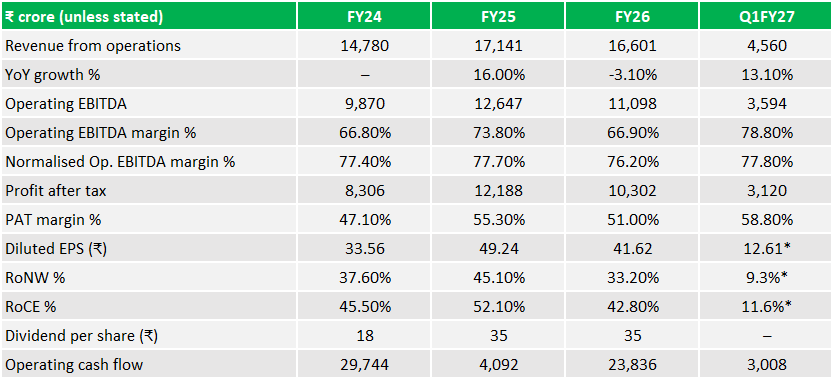
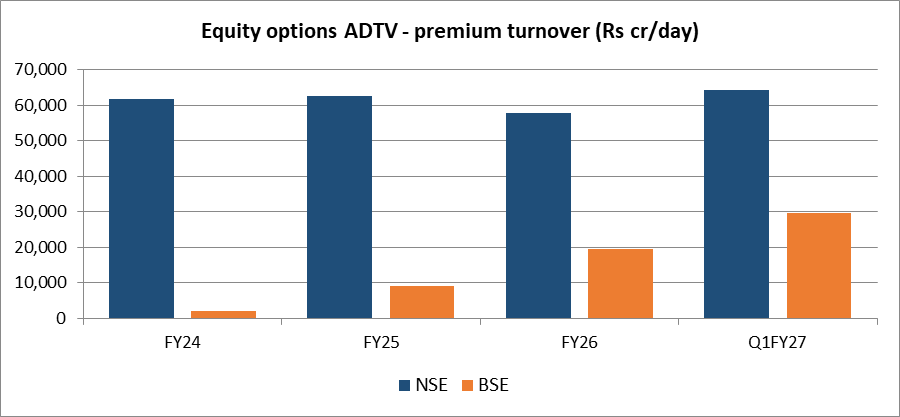
Revenue grew at approximately 6% CAGR to ₹16,601 crore over Fiscal 2024–2026, but the latest year fell 3.1% and profit after tax 15.5% — and the headline overstates the deterioration on both counts. The decline includes a one-time ₹1,391 crore provision against SEBI settlement applications in the Colocation and Dark Fibre matters, the single largest contributor to the 44% jump in other expenses; strip the normalising items out and Normalised Operating EBITDA margin fell just 146 basis points, from 77.7% to 76.2%. The genuine operating hit was narrower — transaction charges fell 4.2% as SEBI’s October 2024 curbs cut equity options premium ADTV, the base on which options charges are levied, from ₹62,449 crore to ₹57,662 crore a day. This was partly offset by a 7.1% rise in options realisation and a 17.3% fall in regulatory fees, which scale with turnover and act as a natural hedge. The June 2026 quarter has already turned: revenue of ₹4,560 crore against ₹4,032 crore in Q1FY26, profit after tax of ₹3,120 crore against ₹2,924 crore, and Operating EBITDA margin of 78.8% against 77.6%. Cash generation is the standout: ₹23,836 crore of operating cash flow against ₹10,302 crore of profit funded an 84% dividend payout.
Key Risks & Red Flags
- Concentration in a segment that is losing share — equity options contributed 60.2% of revenue in Fiscal 2026, and NSE’s share of options premium turnover has fallen from 96.86% in Fiscal 2024 to 68.48% in the June 2026 quarter as BSE has gained. Cash and futures shares are intact, but the erosion sits in the segment carrying most of the earnings and has not yet stabilised.
- SEBI controls both the price and the volume of the core revenue line — the July 2024 “True to Label” circular governs what NSE may charge, and the October 2024 measures governed how much could be traded. Fiscal 2026 showed a single regulatory cycle can shrink revenue outright.
- Pure Offer for Sale, no promoter, concentrated client base — no capital enters the business, and with no identifiable promoter there is no controlling owner with long-term economic alignment. Several public-sector sellers are exiting at a cost of under ₹1 per share. The top ten trading members accounted for 46.78% of revenue in Fiscal 2026.
Outlook
NSE is positioned as the central node of a structurally expanding capital market, supported by near-uncontestable liquidity positions in cash equities and futures, sector-leading margins and returns, and recurring listing, colocation, data-feed and index-licensing lines that grew 12–33% even through the worst year its core has had. The central near-term watch item is the trajectory of options premium share, which has fallen in each of the last three financial years and again in the June 2026 quarter, without a visible floor, alongside the disposal of the pending SEBI settlement applications. The longer-term case rests on India’s financialisation continuing and on NSE converting its lead in liquidity into a broader lead in data, indices and post-trade infrastructure — revenue streams that are less regulated on price and less dependent on volume.
Valuation & View
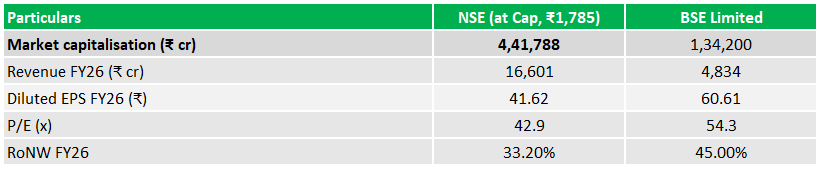
At the upper band of ₹1,785, NSE lists at a market capitalisation of approximately ₹4,41,788 crore, or 42.9x Fiscal 2026 earnings — a 21% discount to BSE, its only listed peer. The discount is not an anomaly: BSE’s earnings grew in Fiscal 2026 while NSE’s fell, precisely because BSE is the beneficiary of the options share NSE has ceded. The market is paying more for the share gainer and less for the share loser.
At 43x, we regard the Offer as fairly valued. The multiple is underpinned by a 76% normalised EBITDA margin, a 42.8% RoCE and near-monopoly positions in cash equities and futures, and the Cap Price sits 8.7% below the ₹1,954.55 at which shares were transacted in the secondary market earlier in 2026.
Based on the above, we assign a Subscribe for Long Term rating to the IPO.

Disclaimer: Investments in the securities market are subject to market risks, read all related documents carefully before investing. Securities quoted here are exemplary, not recommendatory. Please consult your financial advisor before investing. Please note that we do not guarantee any assured returns for the securities quoted here.
Research disclaimer: Investment in the securities market is subject to market risks. Read all the related documents carefully before investing. Registration granted by SEBI, and certification from NISM in no way guarantee the performance of the intermediary or provide any assurance of returns to investors.
For more details, please read the disclaimer.