Usha Martin Ltd. – Engineered to Transform
Usha Martin Limited, established in 1960 and headquartered in Kolkata, India, is a leading global and India’s No. 1 specialty steel wire rope solutions provider, with operations spanning wire ropes, wires, low relaxation prestressed concrete steel strand (LRPC), and bespoke end-fitments and accessories. The Company operates wire rope manufacturing facilities in Ranchi, Hoshiarpur, Dubai, Bangkok and the UK, backed by R&D centres in Italy and Ranchi, and serves end-markets spanning Engineering, Oil & Offshore, Cranes, Construction & Infrastructure, Elevators, Auto and Mining.
Products and Services
The company specialises in high-performance, high-value speciality wire ropes, low relaxation prestressed concrete (LRPC) strands and wires, prestressing solutions, cables, and bespoke end-fittings and accessories, catering to critical sectors such as mining, infrastructure, and maritime logistics.
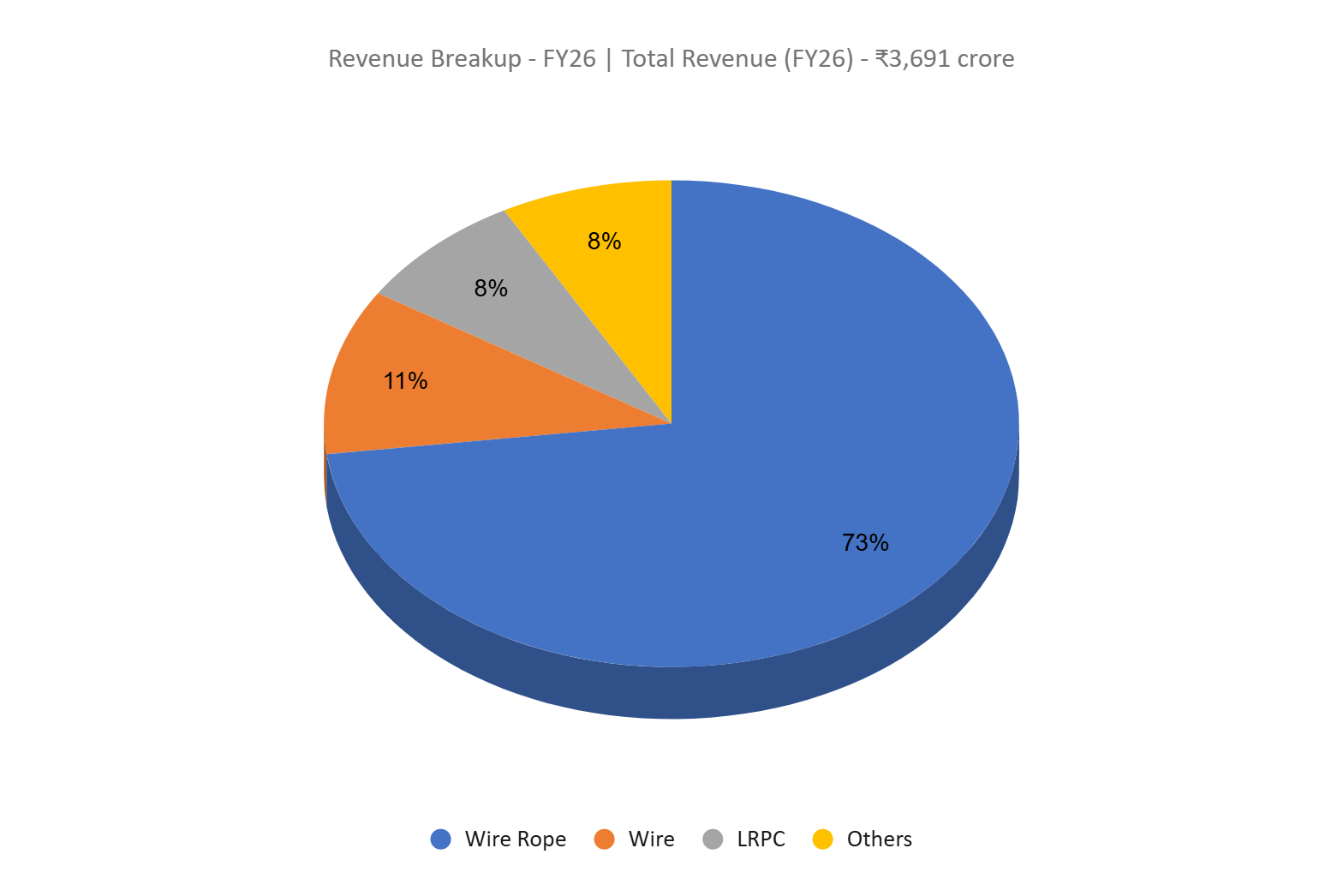
Subsidiaries: As of FY25, the company has 21 subsidiaries and 2 joint ventures.
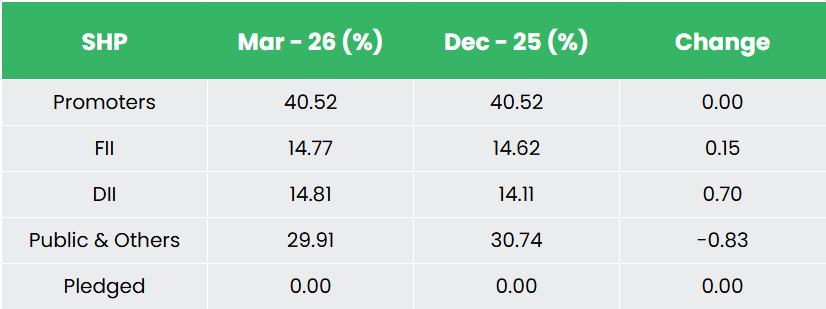
Investment Rationale
- Balance Sheet Strength & Margin Resilience – Usha Martin’s international business scaled meaningfully during the period, with Europe and America showing good traction across cranes, elevators, and mining applications, even as Middle East volumes came in below normal levels; international revenue now constitutes 57% of total revenue. Operating cash flow stood at ₹736 crore, translating into a conversion of approximately 104% of operating EBITDA, and after funding capex of ₹198 crore, free cash flow stood at ₹457 crore. The company closed the year with a consolidated net cash position of ₹332 crore, a sharp turnaround from a net debt position of ₹63 crore in the previous year, with standalone operations now entirely debt-free. ROCE improved to 20.6% from 19.3%, while net working capital days improved to 194 days from 199 days a year earlier. The company navigated Middle East softness by building additional raw material inventory proactively, passing on input cost increases in Wire and LRPC to protect margins, and shifting Rope product mix toward higher value-added applications. Under the One Usha Martin initiative, cost savings of ₹65-70 crore were delivered over the last 18 months through cost discipline and revenue-sharing references.
- Capacity Expansion Underway – The company has invested in expanding capacity and deepening its technical capabilities in high-performance ropes in India, with Ranchi’s upgraded manufacturing capability and the integration of the Brunton Shaw brand enabling execution of larger, more complex projects for global OEMs and end users. Current capacity utilisation stands at 75% for Rope (140,000 tons), 75-78% for Wires (80,000 tons), 70% for normal LRPC (60,000 tons), and 70% for Plasticated LRPC (6,000 tons), leaving headroom across segments. The company plans to add close to 6,000 tons of Rope capacity, with approximately 70-75% of the related capex directed toward this expansion, and the balance toward specialized wire capacity and Plasticated LRPC equipment and testing facilities. Demand from Europe and the US remains strong, and the company holds healthy order visibility for H1.
- Growth Levers Beyond Core Markets – Key growth plans center on scaling value-added rope applications in oil and offshore, elevators, port cranes, and mining. Newer business verticals – Oceanfibre synthetic rope and Plasticated LRPC – are maturing, with meaningful scale-up expected in FY27 and beyond. The company has guided for capex of ₹300 crore over the next two years specifically to increase elevator rope manufacturing capacity, signaling a clear bet on this segment. Capital allocation is supported by strong internal cash generation, with the company having moved from a net debt position of ₹63 crore to a net cash position of ₹332 crore, funding growth largely through internal accruals. The company is also exploring selective organic and inorganic opportunities in markets where its footprint is currently limited, particularly to strengthen its presence in value-added and rigging segments and to get closer to customers globally. Additional opportunities are being evaluated in specialized wires and further expansion of Plasticated LRPC capacity, alongside the broader capacity expansion already underway.
- Q4FY26 – On a consolidated basis, the company reported revenue from operations of ₹979 crore in Q4FY26, up 9.3% YoY from ₹896 crore in Q4FY25 (and up 6.8% QoQ from ₹917 crore in Q3FY26). Operating EBITDA grew 51.6% YoY to ₹211.5 crore, with the operating EBITDA margin expanding to 21.6% from 15.6% in Q4FY25 – the highest quarterly EBITDA since the sale of the Company’s steel business, driven by a richer product mix, a higher share of high-performance ropes, and continued cost discipline. PAT from continuing operations rose 53.7% YoY to ₹155.1 crore (15.1% margin); after a ₹7.1 crore loss from discontinuing operations, reported PAT stood at ₹148.0 crore, up 46.7% YoY. Basic EPS (not annualised) was ₹4.85 versus ₹3.32 in Q4FY25.
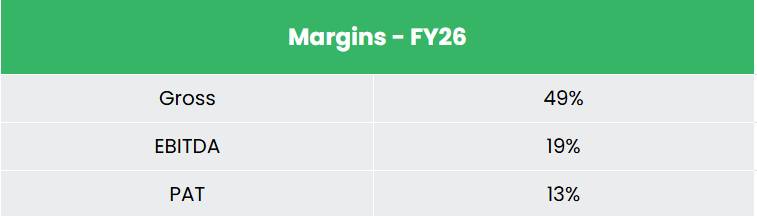
- FY26 – In FY26, consolidated revenue from operations grew 6.2% YoY to ₹3,691 crore. Operating EBITDA grew 18.1% YoY to ₹705 crore, with margins expanding to 19.1% from 17.2% in FY25. PAT from continuing operations grew 20.9% YoY to ₹491 crore, while reported PAT after a ₹24.9 crore loss from discontinuing operations grew 14.8% YoY to ₹466 crore (12.6% margin).
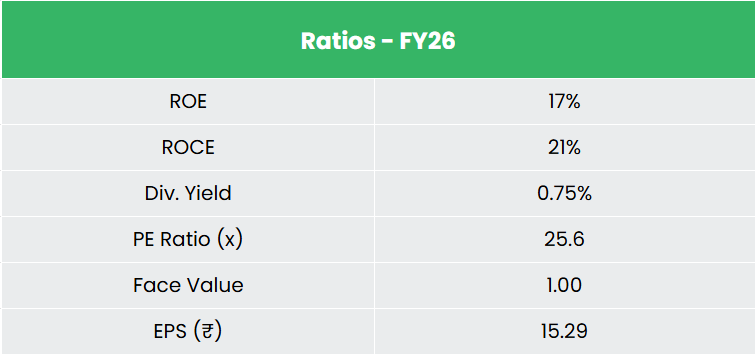
- Financial Performance – The 3-year average revenue and net profit CAGRs are around 4% and 13%, respectively (FY24-26). The return profile remains robust, with the 3-year average ROE and ROCE at around 17% and 20%, respectively. The company has negligible leverage, with a D/Ex of 0.07, supported by interest coverage of ~34x.
Industry
Infrastructure remains a critical enabler in India’s journey toward becoming a US$ 26 trillion economy, with continued investment in physical infrastructure, alongside ease-of-doing-business reforms, seen as central to improving efficiency and lowering costs across the economy. The government has reinforced this focus through initiatives such as the US$ 1.3 trillion Gati Shakti master plan, aimed at driving systemic reform and coordinated infrastructure development, which has already shown meaningful progress. Strengthening infrastructure support for manufacturers is also a key priority, given its role in making freight movement and export logistics more efficient and cost-effective. As a sector spanning power, roads, bridges, dams, and urban development, infrastructure continues to act as a catalyst for broader economic growth, driving allied sectors such as housing, townships, and construction. Given its scale and centrality to national development, the sector remains a sustained area of policy focus aimed at time-bound creation of world-class infrastructure in the country.
Growth Drivers
- India’s infrastructure growth is being accelerated through strong policy support such as PM GatiShakti, the National Logistics Policy, and the Smart Cities Mission, along with large-scale investments in highways, railways, metros, and digital infrastructure, strengthening connectivity, logistics efficiency, and long-term economic development.
- India’s steel demand is expected to grow by around 9% in FY26, driven by infrastructure development, construction activity, and industrial growth, underpinned by continued infrastructure focus in the Union Budget 2026-27 and the National Infrastructure Pipeline (Rs. 111 lakh crore/US$ 1.4 trillion for FY19-FY25, with energy, roads, urban, and railways together accounting for ~71% of projected investment).
- 100% FDI is permitted in the steel sector via the automatic route, while a 30% export duty applies on iron ore (lumps and fines, except low grade) to secure domestic raw-material supply.
Peer Analysis
Competitors: Godawari Power & Ispat Ltd, Gallantt Ispat Ltd, etc.
Compared to peers, Usha Martin runs a more integrated model spanning speciality steel, wire rods, and wire ropes, catering to mining, infrastructure, and industrial applications. Usha Martin’s current-year return ratios rank amongst the best in the peer set, reflecting a lean, low-leverage balance sheet.

Outlook
Management has guided for an operating margin of 20% going forward, supported by an expected volume growth of 10-12%. Capex of Rs. 300 crore is planned over the next two years, with the majority directed toward expanding elevator rope manufacturing capacity by close to 6,000 tons, while the remainder will augment specialized wire capacity and add equipment and testing facilities for Plasticated LRPC. Plasticated LRPC sales are targeted at 6,000-7,000 tons per annum, in line with current capacity pending certain approvals, with plans to scale further to 8,000-9,000 tons per annum thereafter. The company also intends to pursue selective inorganic growth opportunities to expand its global footprint, particularly in value-added and rigging segments, and to strengthen proximity to customers in markets where its presence remains limited.
Valuations
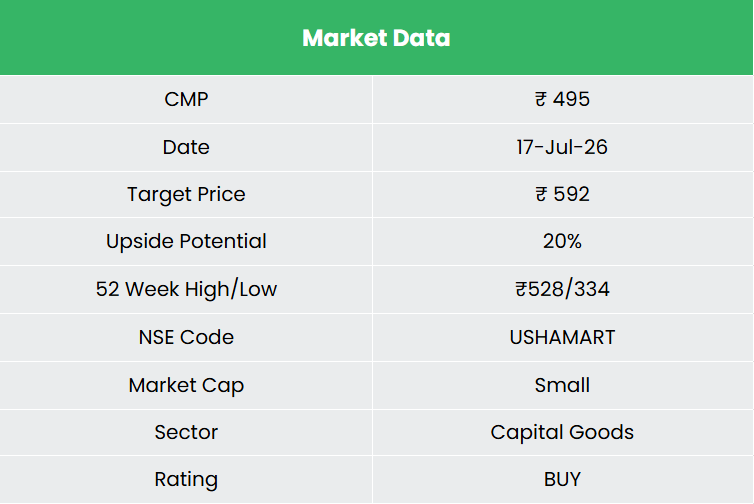
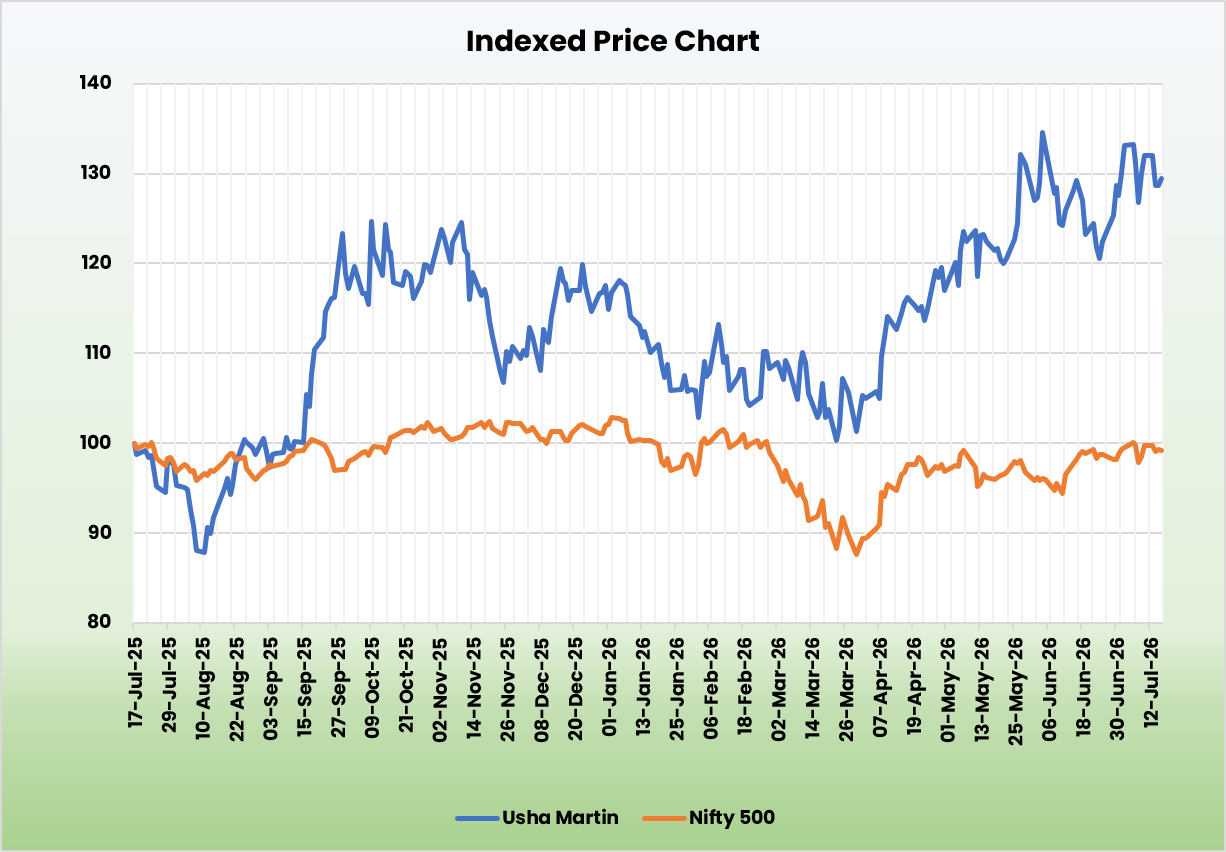
Cost optimisation has already lifted margins, and we believe this benefit is expected to scale further as volumes pick up, with capacity expansion and improving utilisation set to reinforce the growth trajectory. We recommend a BUY rating in the stock with the target price (TP) of ₹592, 23x FY28E EPS. We also encourage maintaining a stop-loss at 20% from the entry price to manage potential downside risk effectively.
SWOT Analysis
| Strength | Weakness |
|
|
| Opportunities | Threats |
|
|

Disclaimer: Investments in the securities market are subject to market risks, read all related documents carefully before investing. Securities quoted here are exemplary, not recommendatory. Please consult your financial advisor before investing. Please note that we do not guarantee any assured returns for the securities quoted here.
Research disclaimer: Investment in the securities market is subject to market risks. Read all the related documents carefully before investing. Registration granted by SEBI, and certification from NISM in no way guarantee the performance of the intermediary or provide any assurance of returns to investors.
For more details, please read the disclaimer.