Company Overview
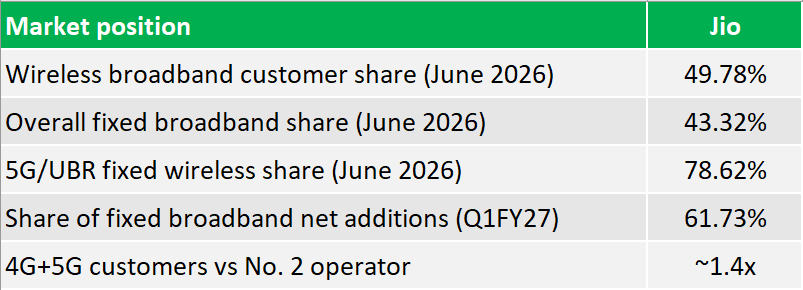
Jio Platforms Limited is India’s largest digital connectivity provider and operates in two layers. The connectivity layer, its subsidiary Reliance Jio Infocomm Limited (“RJIL”), owns the licences, spectrum and network and serves 533.3 million customers across mobile, home broadband (28.6 million JioFiber and JioAirFiber customers) and enterprise connectivity. The platform layer, at the company level, develops the in-house technology stack the network runs on and sells digital services built on it, such as entertainment, cloud and IoT. Scale is the core of the business: roughly every second wireless broadband connection in India is on Jio (a 49.78% share), about 60% of the country’s wireless data traffic runs on its network, and it holds more spectrum than any other operator.
Earnings are primarily driven by connectivity: RJIL contributed 87.74% of revenue and 94.88% of EBITDA in Fiscal 2026, and pre-paid plans, sold through Reliance Retail as sole distributor, made up 77.08% of revenue — a consumer subscription model that grows by adding users and homes and raising monthly spend per user. Digital services are small but growing fast, at ₹16,167 crore of standalone revenue, up approximately 36%. Reliance Industries Limited (“RIL”) is the Promoter with 66.43%, alongside affiliates of Meta (9.98%) and Google (7.73%) and global financial and sovereign investors.
Offer Summary
The company is undertaking a book-built issue at a price band of ₹1,065 to ₹1,119 per Equity Share of face value ₹10, comprising entirely a Fresh Issue of up to 270,000,000 Equity Shares aggregating up to ₹30,213 crore at the Cap Price. There is no Offer for Sale, and the Issue represents approximately 2.93% of post-Issue equity.
Objects of the Offer
- Prepayment, in full or in part, of certain borrowings of the Material Subsidiary, RJIL — ₹27,500 crore, out of ₹29,917 crore of identified foreign-currency term loans; and
- General corporate purposes (not exceeding 25% of the gross proceeds).
About 91% of the gross proceeds at the Cap Price retire debt, cutting borrowings of ₹61,372 crore at June 30, 2026 by about 45% (by about 15% including spectrum dues and leases) and leaving cash and marketable securities of ₹51,833 crore well above the remaining borrowings. At 1.40%–5.13%, these loans sit at the lower end of the group’s 1.40%–8.55% term-loan range, so the interest saving is modest; the real gain is balance-sheet headroom.
Industry Snapshot
According to the Analysys Mason Report commissioned by the company, India’s mobile connectivity market is projected to grow from ₹2.9 trillion in Fiscal 2026 to ₹5.2 trillion by Fiscal 2031 (approximately 12% CAGR), driven by customer additions and mobile broadband ARPU rising from ₹199.5 to ₹326.4 a month. Fixed broadband is the faster-growing pool, projected to expand from ₹340–350 billion to ₹920–930 billion (approximately 22% CAGR), as household penetration of ~21% narrows the gap to a global average above 70%. The growth case therefore rests mainly on monetising connectivity better, with digital services an option on top.
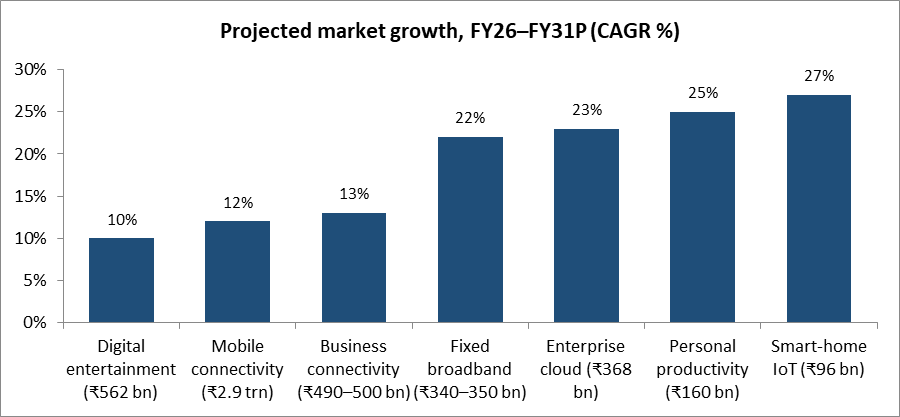
Key structural growth drivers include:
- 2G-to-4G/5G migration — 261.0 million users remain on 2G, and mobile broadband penetration is projected to rise from 69.62% to 87.82% of the population by Fiscal 2031;
- Rising data intensity — monthly wireless data usage of 26.7 GB per customer is projected to reach 59.2 GB by Fiscal 2031, supporting migration to higher-value plans; and
- Under-penetrated homes and small businesses — fixed broadband reaches ~43% of urban and ~7% of rural households, and fewer than 4 million businesses have fixed broadband, against over 79 million MSMEs.
Investment Rationale
Scale leadership
Jio added ~27 million net active mobility customers in Fiscal 2026, about three times the No. 2 player, and its network averaged 107.3 Mbps against 58.2 Mbps for the next-best in Q3 Fiscal 2026. It is the only Indian operator with spectrum in all three 5G bands: 700 MHz, combined with mid-band, carries 5G deep indoors, while 26 GHz enables high-capacity fixed wireless access. Its network architecture also keeps the operating cost per GB below the industry average, which in a largely fixed-cost business makes the lead self-reinforcing.
The capex cycle has peaked and cash generation has inflected
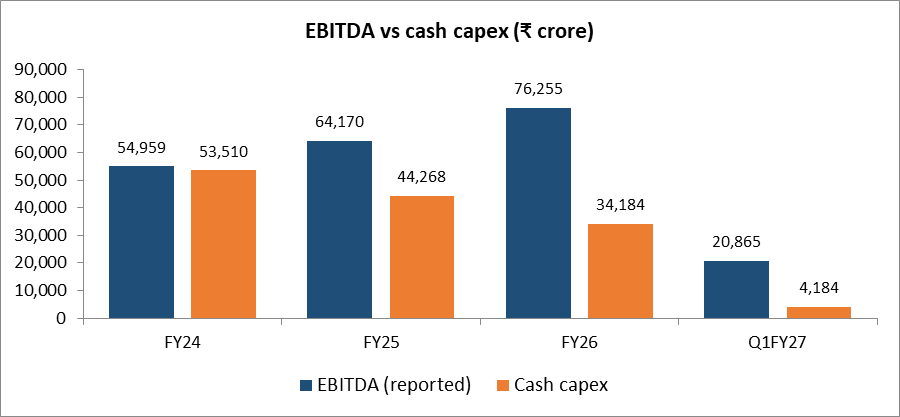
Cash capex fell from ₹53,510 crore, or 48.84% of revenue, in Fiscal 2024 to ₹34,184 crore (23.27%) in Fiscal 2026 and 10.68% in the June 2026 quarter, while EBITDA rose approximately 39%. EBITDA less cash capex has consequently expanded from ₹1,449 crore to ₹42,071 crore, converting 55.17% of EBITDA into surplus cash against 2.64% two years earlier.
ARPU and the home: two levers with headroom
The first and primary lever is pricing. ARPU — the average monthly revenue Jio earns per user — rose from ₹181.7 in the March 2024 quarter to ₹215.6 in the June 2026 quarter, helped by the industry-wide tariff increase in the second quarter of Fiscal 2025 and the shift to 284.9 million 5G users. At ₹215.6, Jio still earns less per user than Bharti Airtel’s India mobile ARPU of ₹263.9 (measured on a different basis) and sits well below the ₹326.4 the industry is projected to reach by Fiscal 2031, leaving room for ARPU to rise further — though gains here depend on the whole industry raising tariffs, which rivals or TRAI can resist.
The second lever is home broadband. JioFiber and JioAirFiber connections more than doubled from 11.2 million in March 2024 to 28.6 million by June 2026, up 43.00% in the past year alone. With fixed broadband still reaching only about a fifth of Indian households.
Financial Performance
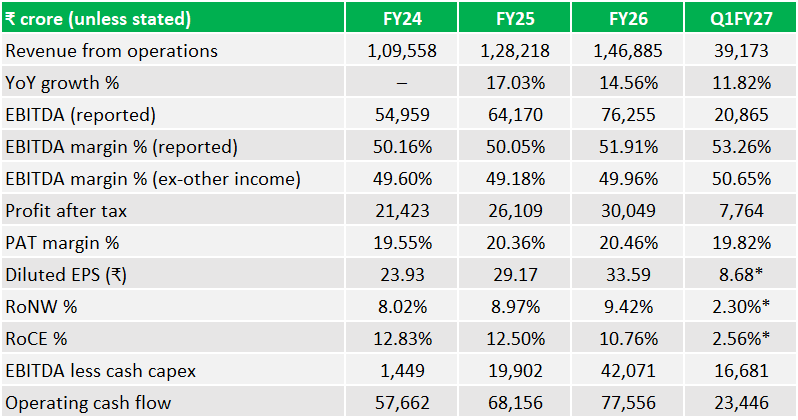
Most of the reported margin expansion came from other income, largely treasury interest; on an operating basis the margin has held at about 50%. Fiscal 2026 profit was also lifted by extending the useful life of certain network assets from 16 to 18 years, which cut depreciation by ₹1,841 crore; without it, profit before tax would have grown approximately 10% rather than 14.88%. With 5G assets now being depreciated and their financing costs expensed, profit is growing slower than EBITDA (9.20% against 15.05% in the June 2026 quarter). Cash is the stronger read: operating cash flow was more than two and a half times profit in Fiscal 2026.
Key Risks & Red Flags
- Deep dependence on the Reliance Group — Reliance Retail is the sole distributor of pre-paid plans (77.08% of Fiscal 2026 revenue), the Promoter supplies data centres, and the “Jio” trademark is owned by RIL — licensed royalty-free, but terminable if RIL loses control. With RIL holding approximately 64.48% post-Issue, minority shareholders have little say over how value is shared within the group.
- Debt is higher than the headline suggests — reported net debt of ₹9,539 crore excludes ₹1,04,514 crore of spectrum dues and ₹12,168 crore of leases. Counting spectrum dues as debt, as Bharti Airtel does, net debt is about ₹1,14,053 crore — 1.44x annualised June-quarter EBITDA excluding other income (1.59x with leases) against Bharti’s 1.17x — falling to about 1.09x (1.24x) after the ₹27,500 crore prepayment. Contingent liabilities of ₹1,469 crore also exclude ₹6,796 crore of disputed GST demands.
- Share supply as lock-ins lapse — the listing-day float consists mainly of the 2.93% issued in the IPO. Pre-Issue holdings of investors other than RIL — about 32.6% of post-Issue equity, worth about ₹3,35,833 crore at the Cap Price, roughly 11 times the Issue — are locked for six months from allotment (subject to SEBI exemptions for certain fund categories), and RIL’s stake for one to three years. Selling as these lapse could weigh on the stock, though no holder is obliged to sell.
Outlook
Jio comes to market as the scale leader in an industry that has moved from a land-grab to monetisation. Near-term, the watch items are ARPU growth, which slowed to 3.26% year on year in the June 2026 quarter and depends on industry-wide tariff action that competitors or TRAI can resist, and whether the operating margin moves meaningfully beyond 50% as fixed broadband scales. The longer-term case rests on converting 533.3 million customers into buyers of higher-value plans and digital services, and on its technology stack finding paying customers overseas — monetisation the company has not yet begun.
Valuation & View
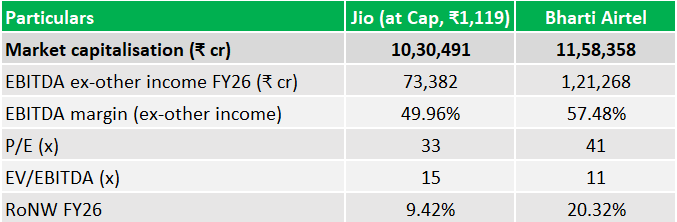
At the upper band of ₹1,119, Jio lists at a market capitalisation of approximately ₹10,30,491 crore, or 33x Fiscal 2026 diluted earnings (34x post-Issue) — an 18% discount to Bharti Airtel’s 41x. On like-for-like EV/EBITDA the picture inverts: 15x against 11x.
The divergence reflects what each multiple captures. P/E is struck after depreciation, interest, tax and minority interests, and so depends on capital structure and accounting policy; EV/EBITDA values the whole enterprise, including debt and spectrum dues, against operating profit, making it the cleaner comparison between operators. More of Jio’s operating profit reaches its shareholders — depreciation and interest absorbed 24% of revenue in Fiscal 2026 against 35% at Bharti, where minorities also took 21% of profit — and Jio’s profit was further lifted by other income and longer asset lives. On operating profit alone, Jio is priced at a premium.
That premium buys the scale leader at the turn of its capex cycle. Against Bharti’s India business alone, Jio is also growing revenue faster — 14.56% against 10.72% in Fiscal 2026 — and the Issue brings its leverage roughly in line with Airtel’s. We regard the Issue as fully but fairly priced, with the risk-reward supporting participation for long-term investors.
Based on the above, we assign a Subscribe rating to the IPO.

Disclaimer: Investments in the securities market are subject to market risks, read all related documents carefully before investing. Securities quoted here are exemplary, not recommendatory. Please consult your financial advisor before investing. Please note that we do not guarantee any assured returns for the securities quoted here.
Research disclaimer: Investment in the securities market is subject to market risks. Read all the related documents carefully before investing. Registration granted by SEBI, and certification from NISM in no way guarantee the performance of the intermediary or provide any assurance of returns to investors.
For more details, please read the disclaimer.