Company Overview
Laser Power & Infra Limited is an integrated manufacturer of power cables, conductors and other specialised products for India’s power transmission and distribution industry, with an operating history of over three decades. In 2015 it forward-integrated into the engineering, procurement and construction (“EPC”) segment, delivering turnkey rural and urban electrification, distribution infrastructure and substation projects. It operates two segments – Manufacturing (power and control cables, speciality products and conductors) and EPC.
Laser Power is one of the leading players by manufacturing capacity for power cables and conductors in East India, running three West Bengal facilities with a combined installed capacity of 85,448 MT as of March 31, 2026, and is an RDSO-accredited registered supplier to Indian Railways. As of the same date, it carried an Order Book of ₹3,243.4 crore, operations spanning 26 states, four union territories and 10 countries, over 43 completed and 34 ongoing EPC projects, and 699 permanent employees.
Objects of the offer
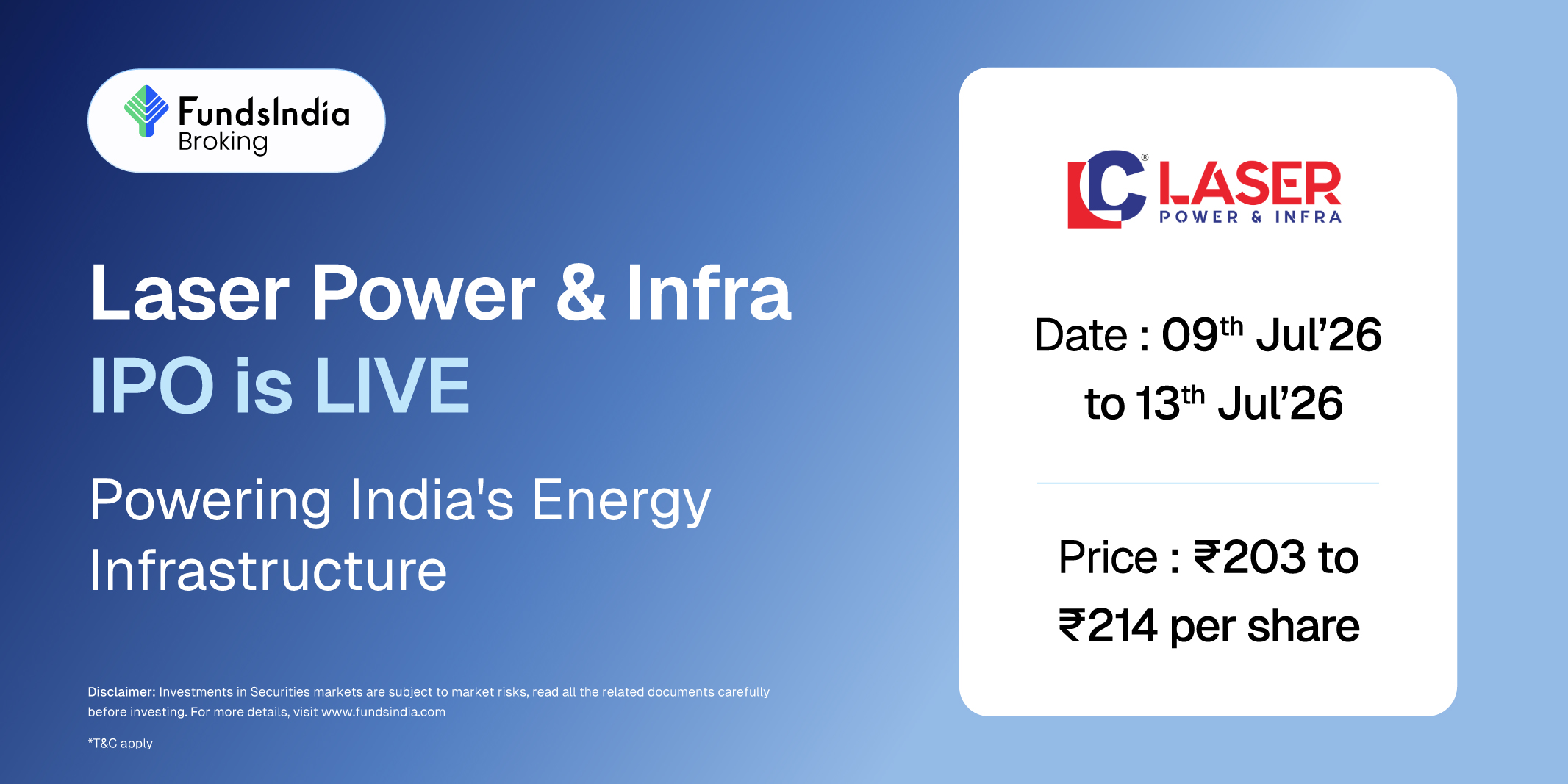
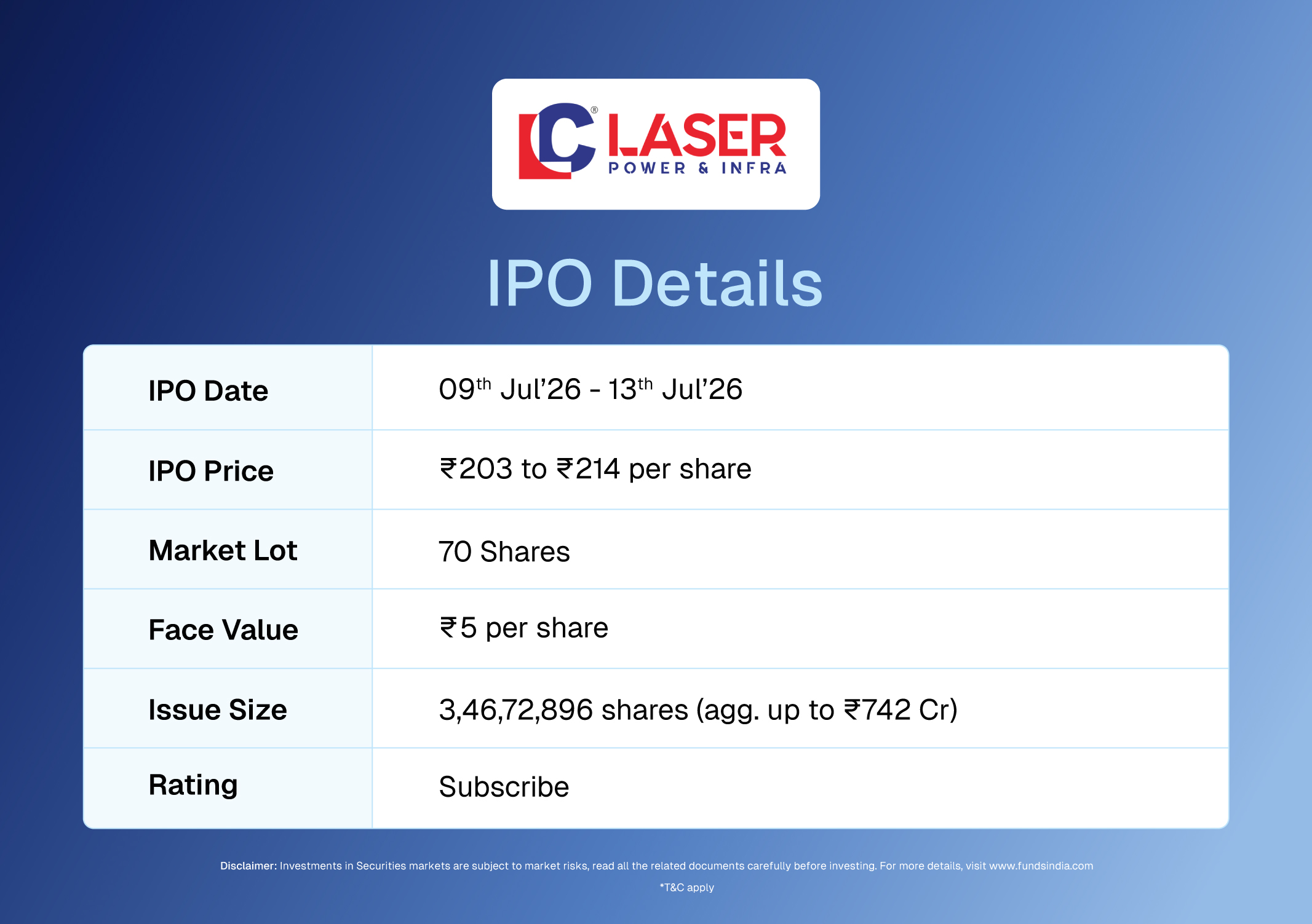
The company is undertaking a book-built issue of Equity Shares of face value of ₹5 each, comprising a Fresh Issue aggregating up to ₹542.00 crore by the Company and an Offer for Sale of up to ₹200.00 crore by the Promoter Selling Shareholders.
The proceeds of the Fresh Issue are to be utilized towards the following objects:
- Pre-payment or re-payment, in full or in part, of certain outstanding borrowings availed by the Company, for which ₹490.00 crore of the Net Proceeds is earmarked against total outstanding borrowings of ₹935.67 crore as on June 17, 2026.
- General corporate purposes (not exceeding 25% of the Gross Proceeds).
Investment Rationale
- Backward-integrated dual-engine model spanning manufacturing and EPC: Laser Power pairs three West Bengal manufacturing units (85,448 MT installed capacity) with a turnkey EPC business, and the two engines feed each other: cables and conductors for EPC projects are sourced in-house, with captive transfers rising from ₹259.64 crore in FY24 to ₹354.39 crore in FY26 (+36%), while backward integration extends into intermediate products such as aluminium rods and PVC compounds. Barring select civil works, no EPC work is outsourced to third-party subcontractors, allowing the company to control timelines and bid competitively on tenders by leveraging cross-feeding economics. The EPC engine has scaled rapidly – revenue nearly tripled (~2.9x) over FY24–FY26 to ₹635.07 crore, lifting its share of revenue from 12.57% to 27.30% – and against this integrated backdrop, EBITDA margin expanded 403 bps over FY24–FY26 to 12.96%.
- Entrenched East India franchise protected by approved-vendor entry barriers: The company is one of the leading players by manufacturing capacity for power cables and conductors in East India, an RDSO-accredited registered supplier to Indian Railways, and among the largest approved vendors of railway signalling, quad and underground power cables in the region (per CRISIL). Supplying government agencies requires pre-qualification on track record, technical capability and financial strength – a structural entry barrier behind which Laser Power serves Indian Railways and the four TP Odisha DISCOMs, with government customers contributing 65.16% of FY26 revenue (up from 53.70% in FY24). Execution credentials compound the moat: 43+ completed EPC projects under RGGVY, DDUGJY, Saubhagya and RDSS, over 85,191 ckm of distribution lines and 113+ substations commissioned, including projects in flood-prone riverine islands and terrain where it was the sole bidder (Kalahandi, Odisha) – capabilities that matter as RDSS-led network upgradation concentrates spending in Eastern India.
- TS Conductor partnership creates an option on India’s transmission and reconductoring upcycle: Through a strategic manufacturing agreement with U.S.-based TS Conductor Corp, Laser Power is qualified to locally manufacture advanced composite-core conductors – AECC, HTLS, ACSS, AL-59 and eco-conductors – with AECC offering thermal stability up to 200°C, higher current capacity and minimal sag, making it suited for reconductoring existing lines without expanding right-of-way (per CRISIL). The demand backdrop is substantial: the National Electricity Plan targets transmission line capacity rising from 485,544 ckm in 2024 to 648,190 ckm by 2032, and CRISIL projects the cables and wires market to grow at 11–13% CAGR to ₹2,350–2,550 billion by FY30. The company is already monetising this positioning – it is prequalified and has bid for 18 transmission EPC works of 66 kV and above aggregating approximately ₹900 crore, including HTLS reconductoring, marking a deliberate move up the voltage curve from its 33/11 kV distribution base.
- Record order book meets freshly built capacity headroom: The Order Book stood at ₹3,243.40 crore as of March 31, 2026 – up 40% YoY and 49% over FY24, and roughly evenly split between manufacturing (₹1,668.89 crore) and EPC (₹1,574.51 crore) – providing revenue cover of ~1.39x FY26 revenue. Manufacturing order inflow rose ~57% over two years to ₹2,123.21 crore in FY26. Crucially, the company has pre-built the capacity to serve this book: installed capacity expanded 37.82% over FY24–FY26 to 85,448 MT, taking FY26 utilisation down to 61.59% and leaving substantial headroom to absorb order-book execution without immediate capex.

- Financial Performance: The company reported revenue from operations of ₹2,326.10 crore in FY26, down 9.50% from ₹2,570.40 crore in FY25 – attributable, per the RHP, to lower manufacturing volumes from raw-material shortages and order postponements amid the Middle East crisis, alongside lower EPC execution – though still representing a two-year CAGR of 15.37% over FY24. Profitability, however, decoupled from the top line: EBITDA rose 20.4% YoY to ₹301.44 crore with margin expanding 322 bps to 12.96%, and PAT grew 42.0% YoY to ₹151.59 crore (6.46% margin), a ~3.8x increase over FY24’s ₹40.41 crore. Return ratios are healthy at 23.32% RoE and 17.83% RoCE. The balance sheet is the softer spot – net debt rose to ₹801.36 crore (1.10x equity) and working-capital days stretched to 138 from 88 – which the IPO directly addresses, with the ₹490.00 crore debt repayment retiring over half of outstanding borrowings and easing finance costs from FY27.
Key Risks
- Elevated working-capital intensity and stretched receivables
Laser Power’s operations are working-capital intensive, with net working capital of ₹1,020.66 crore and trade receivables of ₹1,374.96 crore as of March 31, 2026, and debtor days of 196 in FY26. Net working-capital days rose to 138 in FY26 from 88 in FY25, with the cycle funded partly through short-term borrowings (net debt of ₹801.36 crore, 1.10x equity). Because a majority of revenue comes from government entities that carry long credit periods, growth ties up cash before it converts to profit – so continued scale-up will require ongoing working-capital financing and disciplined collection, and any lengthening of receivables would strain liquidity and finance costs.
- Rising customer concentration in a tender-based, government-heavy revenue base: The top-10 customers contributed 72.14% of revenue in FY26, up sharply from 53.37% in FY24, and government customers accounted for 65.16% of FY26 revenue. A significant portion of contracts are tender-based; while the loss of any single customer has historically not been material given this model, the corollary is that revenue depends on continually winning competitive tenders, and rising concentration raises the stakes of any slippage in win rates.
- Commodity-linked input costs and supply-driven volume risk: Primary raw materials – aluminium, steel, copper, XLPE and PVC compound – are commodity- and crude-linked, and cost of materials consumed was ~59.6% of revenue in FY26, leaving margins exposed to price swings. Customer purchase orders generally carry a price-escalation mechanism and the company has largely passed on cost increases, so the risk lies less in pricing than in lags in pass-through and in supply disruption.
Outlook
Laser Power’s outlook is supported by a record order book, freshly built capacity headroom, a backward-integrated manufacturing-plus-EPC model and its entrenched approved-vendor position in East India, underpinned by structural tailwinds from RDSS-led distribution upgradation, National Electricity Plan transmission additions and the TS Conductor reconductoring opportunity. With FY26 volumes curtailed by raw-material shortages and revenue running below the prior year, growth will depend on the normalisation of input supply, timely conversion of the order book, and a deliberate move up the voltage curve into higher-value transmission work. While the business carries an elevated working-capital cycle and a rising, government-heavy customer concentration, the Fresh Issue meaningfully deleverages the balance sheet, with performance contingent on disciplined receivable collection and sustained input-cost pass-through as scale rebuilds.
According to the RHP, the company’s listed peers are Apar Industries Ltd, Polycab India Ltd, KEI Industries Ltd, Dynamic Cables Ltd and Universal Cables Ltd. The peer group is trading at an average P/E of 46.16x, with the highest being 67.05x, and the lowest being 21.05x. At the upper price band, the listing market capitalization of Laser Power will be Rs. 3,003.88 crore, and the company is demanding a P/E of 19.82x, based on the post issue market capitalization and FY26 diluted EPS. When compared to its peers, the issue appears attractively valued, trading at a discount to the peer group. Based on the above views, we provide a ‘Subscribe’ rating for this IPO.

Disclaimer: Investments in the securities market are subject to market risks, read all related documents carefully before investing. Securities quoted here are exemplary, not recommendatory. Please consult your financial advisor before investing. Please note that we do not guarantee any assured returns for the securities quoted here.
Research disclaimer: Investment in the securities market is subject to market risks. Read all the related documents carefully before investing. Registration granted by SEBI, and certification from NISM in no way guarantee the performance of the intermediary or provide any assurance of returns to investors.
For more details, please read the disclaimer.