Company Overview
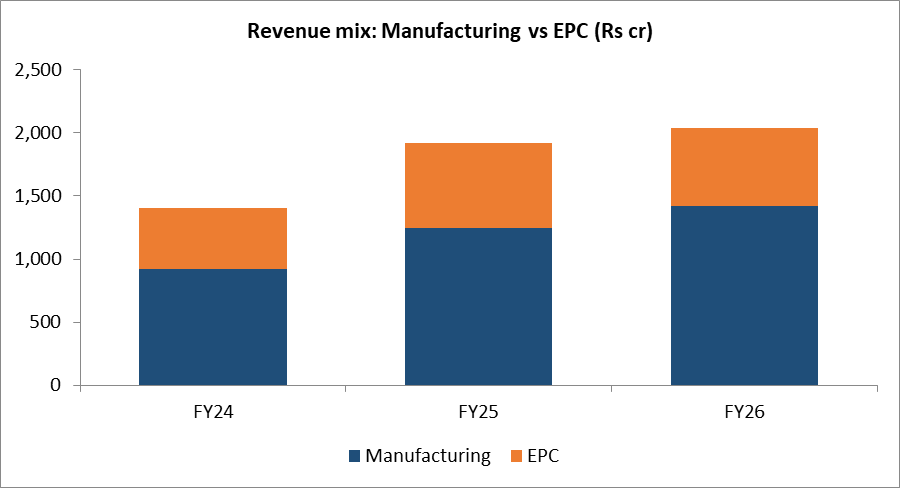
Lumino Industries Limited is a product-driven, integrated engineering, procurement and construction (“EPC”) player in India’s power transmission and distribution (“T&D”) industry, combining in-house manufacturing of aluminium conductors, power cables and electrical wires with T&D project execution. Incorporated in 2005 and headquartered in Kolkata, with manufacturing at Howrah, West Bengal, the company draws on more than three decades of promoter experience in the sector. It operates two reportable segments — Manufacturing and EPC — and captively consumes a portion (23.08% in Fiscal 2026) of its manufactured products within its own EPC projects, a vertical-integration model it uses to improve bidding competitiveness and supply security. Manufacturing contributed approximately 68% of revenue in Fiscal 2026, and the company carried a combined order book of ~₹3,150 crore as at March 31, 2026.
The Manufacturing segment spans aluminium conductors (including high-temperature low-sag, “HTLS”, variants such as ACFR and TACSR), power cables, and electrical wires under the ‘Lumicon’ brand launched in Fiscal 2023, produced at two Howrah facilities with a combined aluminium-consumption capacity of 40,000 MT per year; a new facility at Ranihati, Howrah, is under construction to widen the range. The EPC segment comprises six business lines — power T&D, EHV substations, HTLS re-conductoring, railway electrification, solar and water-management projects. The company supplies conductors and cables to large EPC players including Kalpataru Projects, Jackson, Monte Carlo and R.S. Infraprojects, and executes projects primarily for state and central government utilities. It has cumulatively executed approximately 80,000 km of T&D lines, 44 substations and 41 MW of solar projects, holds a two-star export house status and UL certification, and exports to the United States, several African markets, Nepal and Bangladesh.
Offer Summary
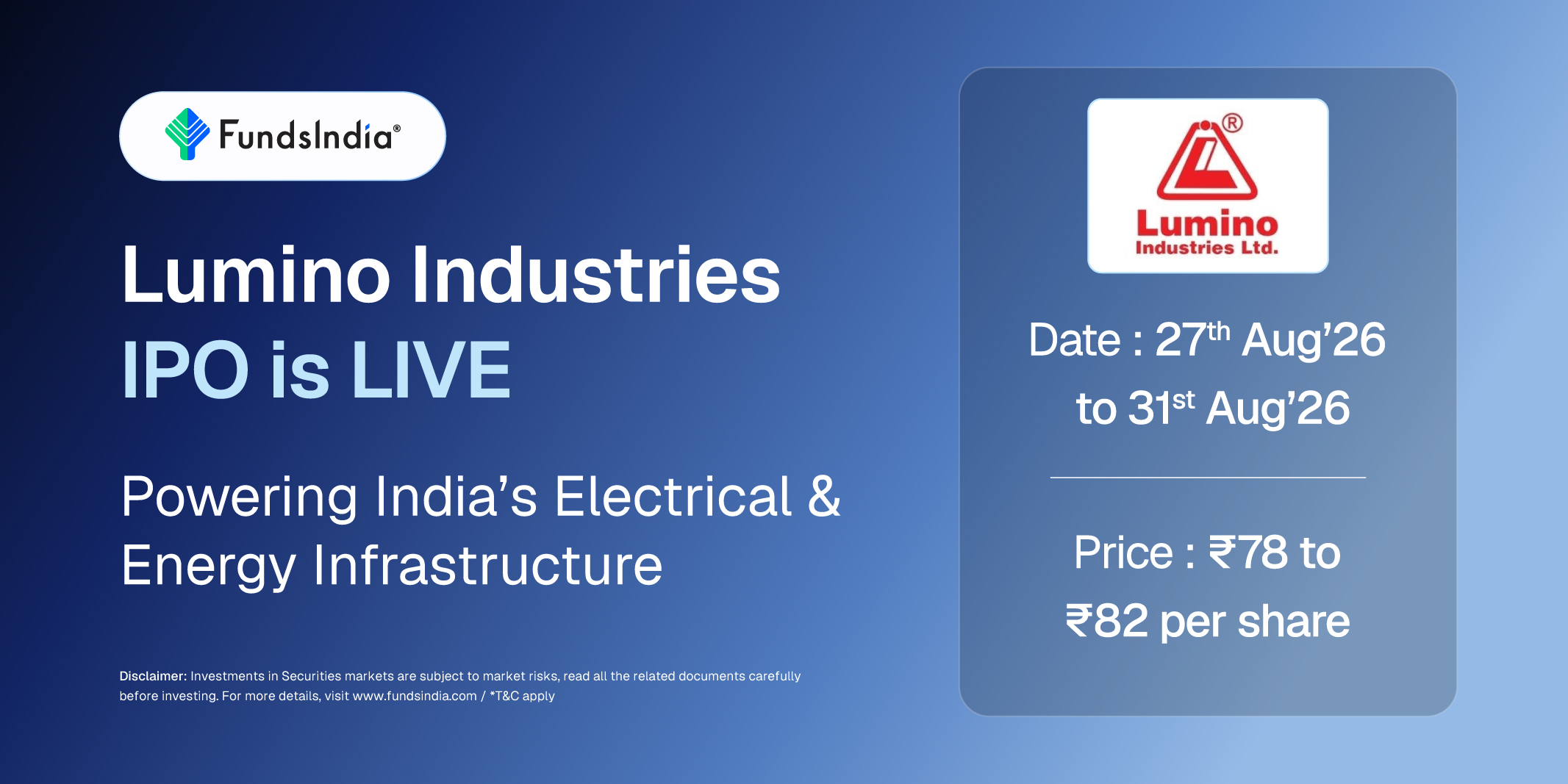
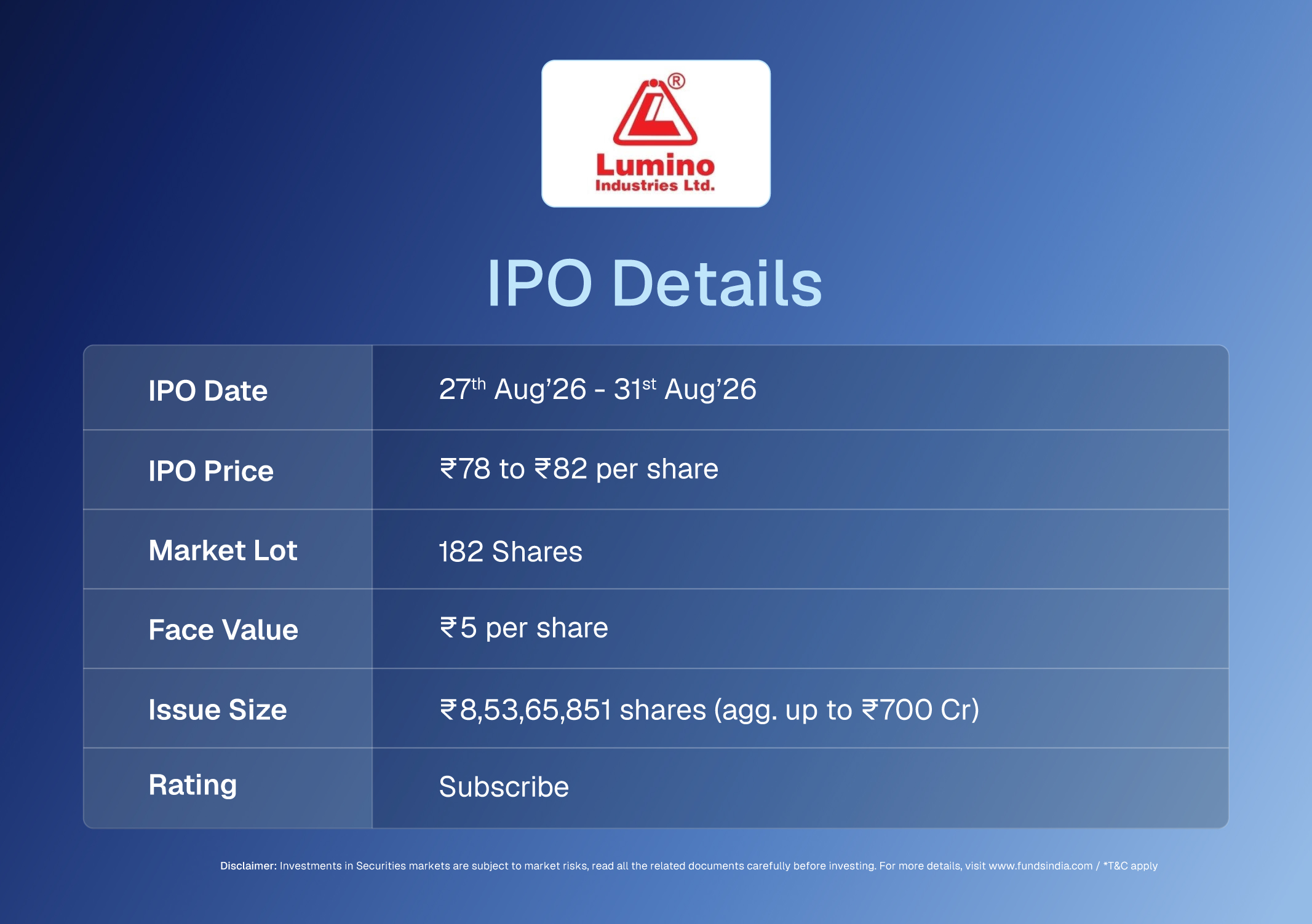
The company is undertaking a book-built issue at a price band of ₹78 to ₹82 per Equity Share of face value ₹5, aggregating approximately ₹700 crore, comprising a Fresh Issue of up to ₹500 crore and an Offer for Sale of up to ₹200 crore by the Promoter Selling Shareholders. The Fresh Issue constitutes approximately 71% of the total Offer.
Objects of the Offer
- Prepayment or repayment, in full or part, of certain borrowings — approximately ₹337 crore from the Net Proceeds of the Fresh Issue, equivalent to approximately 88% of the company’s total borrowings of ₹384 crore as at March 31, 2026;
- Capital expenditure towards the purchase of equipment and machinery, civil works and interior fit-outs; and
- General corporate purposes (not exceeding 25% of the gross proceeds of the Fresh Issue).
The Offer is predominantly a Fresh Issue directed at deleveraging rather than a monetisation of promoter holdings — the promoters together sell only ₹200 crore, or approximately 29% of the Offer. The ₹337 crore of debt repayment near-fully deleverages a balance sheet that was levered largely to fund the Fiscal 2025 working-capital build; the repayment therefore addresses the balance-sheet symptom, with the sustainability of cash conversion the more important watch item (see Key Risks).
Industry Snapshot
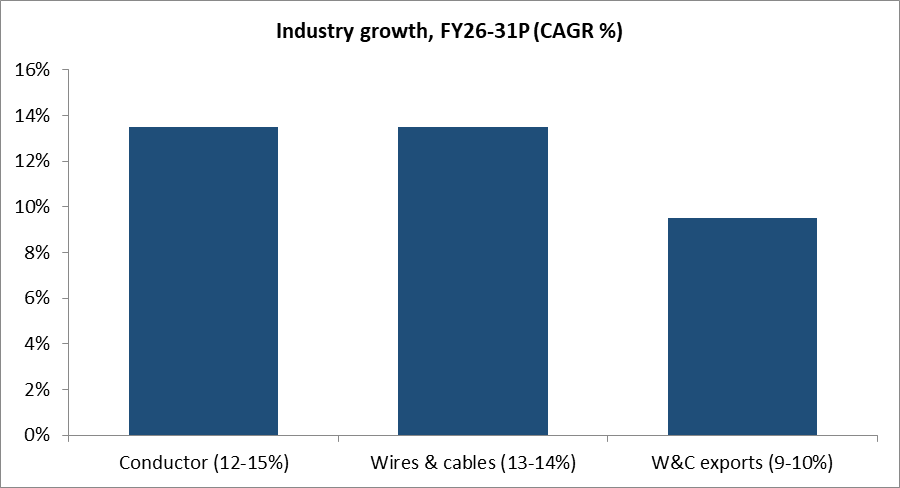
According to the CRISIL Report commissioned by the company, the conductor industry is projected to grow at an approximately 12–15% CAGR and the wires-and-cables market at an approximately 13–14% CAGR over Fiscal 2026–Fiscal 2031, driven by grid expansion, renewable-energy evacuation and the re-conductoring of ageing transmission lines. Demand rests on India’s transmission build-out under the National Electricity Plan (Transmission), which targets transformation capacity rising to approximately 2,345 GVA by Fiscal 2032, alongside Inter-State Transmission System and Green Energy Corridor investments and a structural shift toward higher-voltage (400/765 kV) and HTLS lines. The National Electricity Plan envisages approximately ₹9.15 lakh crore of transmission capital expenditure through 2032 — roughly 191,000 circuit-km of new lines — largely to integrate approximately 500 GW of renewables by 2030, making this a multi-year, government-anchored capex cycle.
Key structural growth drivers include:
- Grid expansion and renewable-energy evacuation under the National Electricity Plan, ISTS and Green Energy Corridors, which lift demand for conductors, cables and T&D EPC;
- Re-conductoring with HTLS conductors on right-of-way-constrained corridors, where higher-ampacity lines are needed without new towers; and
- Rising power demand (approximately 5–7% CAGR over Fiscal 2027–Fiscal 2031) alongside railway electrification and solar build-out.
Investment Rationale
Peer-leading return ratios and capital efficiency
Lumino reported the highest return ratios in its RHP peer set in Fiscal 2026 — RoNW of 24.6% and RoCE of 25.8%, against a peer range of roughly 1–20% — together with the highest asset-turnover ratio (15.8x). This reflects an asset-light, high-throughput base and a growing mix of higher-margin products, achieved at a fraction of the scale of the larger listed peers.

Mix shifting toward higher-margin, lower-working-capital manufacturing
Aluminium-conductor revenue roughly tripled over Fiscal 2024–Fiscal 2026 to become the largest product line, and direct manufacturing sales (on a contractual basis) rose from approximately 22% to 52% of revenue while contractual EPC revenue fell. Manufacturing segment EBIT margin (approximately 13.0% in Fiscal 2026) exceeds the profitability of the EPC-services book and carries lighter working capital, and the manufacturing-skewed Ranihati expansion reinforces the trajectory — a favourable, strategic shift toward the segment the market rewards with a higher multiple.
Integrated, product-driven model
In-house manufacture of the conductors and cables consumed in its own EPC projects (23.08% captive in Fiscal 2026) provides supply security and a bidding cost advantage, and supports the integration of higher-value products such as HTLS into turnkey solutions.
Post-issue deleveraging
Repayment of approximately 88% of borrowings from Fresh Issue proceeds leaves the company near debt-free, removing roughly ₹21 crore of post-tax interest cost and freeing bank-guarantee capacity — an operational constraint on EPC bidding in this sector.
Financial Performance
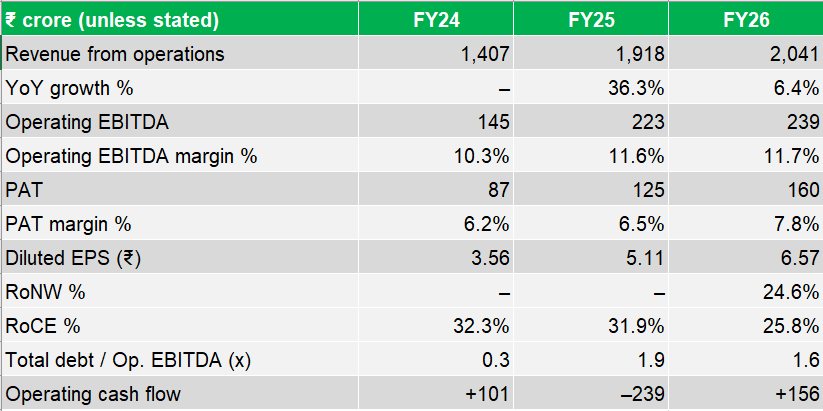
Revenue compounded at approximately 20% to ₹2,041 crore over Fiscal 2024–Fiscal 2026, the Operating EBITDA margin improved to 11.7%, and profit after tax rose to ₹160 crore, with return ratios remaining the strongest in the peer set. Two features temper the quality of the latest year rather than its direction. First, Fiscal 2026 revenue growth of approximately 6% was entirely price-led — physical manufacturing volume fell approximately 4.2% (production 32,960 to 31,571 MT) as realisations rose on higher metal prices — so the headline growth rate overstates underlying volume. Second, reported profit was flattered by a lower effective tax rate (approximately 21.9%, aided by deferred-tax credits) and by other income of ₹48 crore; on a normalised 25% tax rate, Fiscal 2026 profit is closer to ₹154 crore. Operating cash flow, negative ₹239 crore in Fiscal 2025 before recovering to ₹156 crore in Fiscal 2026, underlines that working-capital conversion — not profitability — is the swing factor.
Key Risks & Red Flags
- Working-capital intensity and cash-conversion volatility — receivable days rose from 119 to 160 over Fiscal 2024–Fiscal 2026 and operating cash flow was negative ₹239 crore in Fiscal 2025, funded by debt. Revenue is concentrated in government and utility customers with long payment cycles and retention money, and the post-issue deleveraging addresses the symptom (debt) rather than the cause (working capital), which can re-accumulate as the business grows.
- Price-led growth and commodity exposure — Fiscal 2026 growth was entirely realisation-driven while volume declined, and revenue and working capital are sensitive to aluminium and copper prices, which were elevated through 2026.
- Related-party procurement and offer structure — raw-material purchases from P.S. Enterprise, a promoter-linked entity, of approximately ₹175–270 crore per year represent roughly 15–26% of the materials bill and warrant an arm’s-length assessment; separately, the Offer-for-Sale shares carry a near-nil promoter cost of acquisition, and 14 investment entities were amalgamated into the company ahead of the Offer.
- Off-balance-sheet and order-visibility risk — bank guarantees and letters of credit of ₹902 crore (versus net worth of ₹730 crore) constrain incremental EPC bidding to available banking limits, and EPC revenue is order-book dependent with dependence on a small set of government customers.
Outlook
Lumino is positioned to grow alongside a structurally expanding T&D equipment and EPC market, supported by peer-leading return ratios, a favourable mix shift toward higher-margin manufacturing, and near-full post-issue deleveraging. The central near-term watch item is the trajectory of working capital and cash conversion, which is the principal swing factor for the investment case, alongside the sustainability of Fiscal 2026 margins and volumes given the price-led nature of recent growth. The longer-term case rests on rising T&D and re-conductoring demand and the company’s ability to convert its integration and product mix into sustained, higher-quality, lower-working-capital growth.
Valuation & View
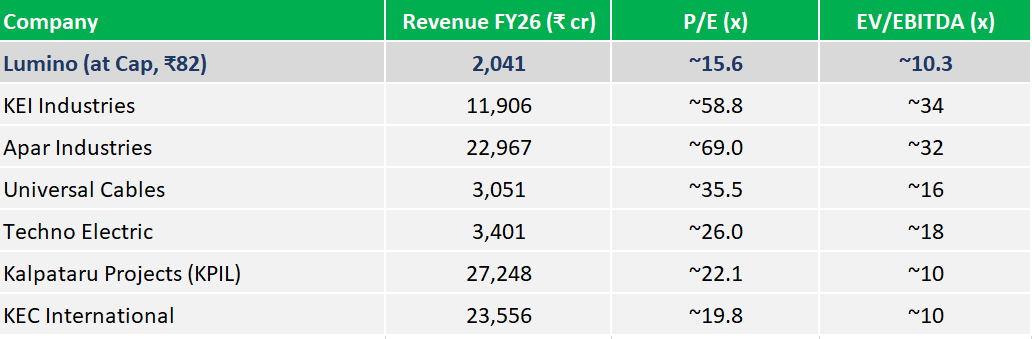
At the upper price band of ₹82, Lumino is valued at a post-issue market capitalisation of approximately ₹2,497 crore, or approximately 15.6x Fiscal 2026 earnings (12.5x on pre-issue EPS, and approximately 16.3x on a normalised 25% tax rate). On EV/EBITDA — the appropriate measure for a working-capital-intensive business whose profit carries tax and other-income noise — the company is valued at approximately 10.3x trailing Fiscal 2026 EBITDA, at approximately 13.8x on a pro-forma post-deleveraging P/E. On both multiples Lumino is priced below every peer in the set while carrying the highest RoNW.
The significance is where that multiple sits. At approximately 10.3x, Lumino is priced at the EPC-peer floor (KEC and Kalpataru at approximately 10x) despite generating roughly 68% of revenue from manufacturing — the segment for which the market pays 16–34x (Universal, Apar, KEI), the discount likely reflects a structurally working capital intensive model, with muted underlying volumes off-late. A reverse-DCF cross-check indicates the band embeds only about 5–8% perpetual growth, well below the approximately 12–15% industry CAGR.
We regard a fair EV/EBITDA range of approximately 10–13x as defensible, implying a value of roughly ₹80–103 per share against the ₹78–82 band — so the Offer is priced at the lower end of fair value.
Based on the above, we assign a Subscribe rating to the IPO.

Disclaimer: Investments in the securities market are subject to market risks, read all related documents carefully before investing. Securities quoted here are exemplary, not recommendatory. Please consult your financial advisor before investing. Please note that we do not guarantee any assured returns for the securities quoted here.
Research disclaimer: Investment in the securities market is subject to market risks. Read all the related documents carefully before investing. Registration granted by SEBI, and certification from NISM in no way guarantee the performance of the intermediary or provide any assurance of returns to investors.
For more details, please read the disclaimer.