Dixon Technologies (India) Ltd. – The brand behind brands
Dixon Technologies (India) Limited, incorporated in 1993, is India’s largest electronics manufacturing services (EMS) and original-design-manufacturing (ODM) company, and the country’s fastest-growing EMS player by revenue and market capitalisation. It manufactures for global and domestic brands across four verticals – Mobile & EMS, Consumer Electronics & Appliances, Home Appliances and Lighting alongside reverse-logistics and component operations, including AC PCBs. Its marquee customer base includes Samsung, Motorola, Xiaomi, OPPO, Vivo, Google, HP, Lenovo, Acer, ASUS, Philips, Panasonic, Lloyd, boAt and Noise, among others. The group operates 24 manufacturing facilities and over 31,000 employees across Uttar Pradesh, Uttarakhand, Andhra Pradesh and Punjab, with a new facility being set up in Chennai (Tamil Nadu).
Products and Services
The company offers a diversified portfolio of electronic manufacturing services (EMS) across the following segments:
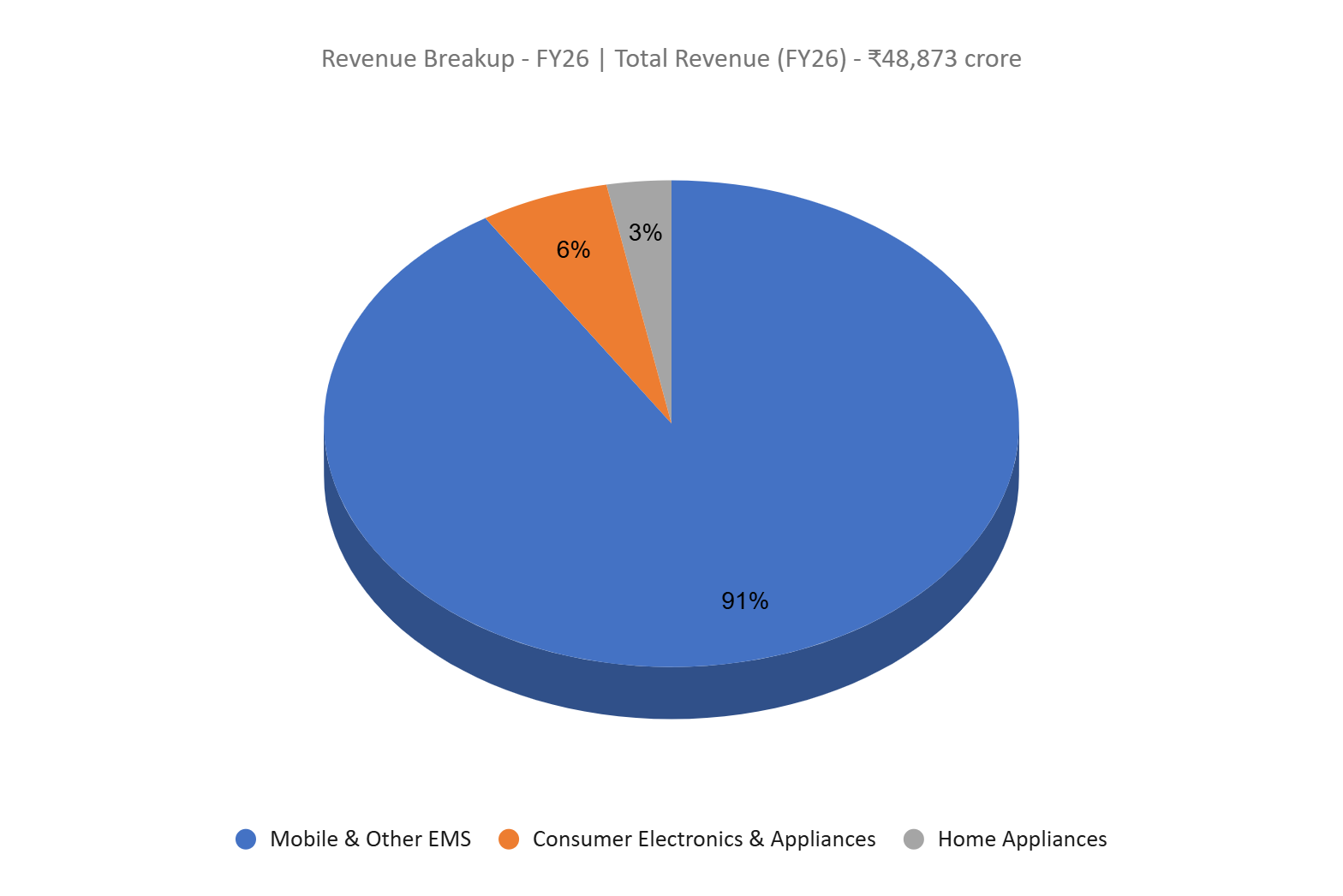
- Mobile Phones & EMS: 4G/5G smartphones, feature phones and OEM/ODM manufacturing services.
- Consumer Electronics: LED TVs, monitors, digital signage and display modules/assemblies.
- Home Appliances: Washing machines and refrigerators.
- Lighting Solutions: LED bulbs, battens, downlighters, panels and professional lighting products.
- Wearables & Hearables: Smartwatches, TWS earbuds and other wearable devices.
- Telecom & IT Hardware: Telecom equipment, networking products, laptops, desktops and other IT hardware.
Subsidiaries: As of FY25, the company has 12 subsidiaries and 2 joint ventures.
Investment Rationale
- Vivo JV – Large volume addition improves revenue visibility: The approval of the Vivo JV removes a key overhang and significantly strengthens Dixon’s smartphone manufacturing franchise. The partnership is expected to contribute 20–22 million smartphone units annually, providing a meaningful addition to existing volumes and improving revenue visibility over the medium term. More importantly, Vivo becomes another large anchor customer, reducing client concentration while improving capacity utilization across manufacturing facilities. The pace of volume ramp-up will be a key monitorable, as faster execution could accelerate revenue growth and operating leverage. Successful integration of Vivo’s production should also strengthen Dixon’s positioning as the preferred EMS partner for global smartphone brands, supporting long-term growth beyond the current order book.
- Backward integration to drive margin expansion and higher value addition: Dixon is steadily moving beyond final assembly into high-value component manufacturing, a structural shift that should improve margins and reduce dependence on imported components. Through Q Tech, camera module capacity is being expanded from 70 million to 180 – 190 million units annually over the next 15 – 18 months, with revenue expected to increase from ₹1,700 crore to ₹2,500 crore, while trials commence in Q3FY27. The 74:26 HKC display module JV, which has received PN3 and ECMS approvals, is expected to begin commercial production in Q4FY27 with Phase I capacity of 24 million mobile displays and 2.4 million automotive/IT displays, eventually scaling to 50–55 million mobile displays. At optimal utilization, the business is expected to generate ₹5,500 – 6,000 crore revenue with double-digit margins. Alongside the Chongqing Yuhai JV for precision mechanical parts, these initiatives deepen domestic value addition and provide a structural offset to the margin impact from the expiry of smartphone PLI benefits.
- Capacity expansion and business diversification support long-term growth: Dixon continues to invest ahead of demand by expanding manufacturing capacity while broadening its product and customer base. The 400,000 sq. ft. Longcheer JV facility is expected to commence operations by Q3FY27, backed by a robust smartphone order book and discussions to manufacture additional product categories. Simultaneously, the company’s 1 million sq. ft. Noida facility for anchor customers is nearing completion and is expected to become operational in Q2FY27, strengthening its telecom, networking and electronics manufacturing capabilities. Growth is also being supported by new export opportunities, with Ismartu set to begin feature phone exports to Africa, taking annual feature phone volumes to nearly 50 million units. In addition, new initiatives in IT hardware, telecom equipment, optical connectivity and display manufacturing diversify revenue streams beyond smartphones, reducing dependence on a single product category and creating multiple long-term growth drivers.
- Q4FY26 – During the quarter, Dixon reported revenue from operations of ₹10,511 crore, up 2% YoY from ₹10,293 crore in Q4FY25, with the Mobile & EMS division (~90% of revenue) contributing ₹9,485 crore. Adjusted EBITDA excluding a ₹75 crore fair-value gain on the Aditya Infotech stake stood at ₹418 crore, down 8% YoY, with adjusted EBITDA margin at 4.0% versus 4.4% in Q4FY25; reported EBITDA including the gain was ₹493 crore. Reported net profit (after non-controlling interest) came in at ₹256 crore, down 36% YoY, but the fall is optical – the base quarter carried a larger ₹250 crore fair-value gain. Adjusted for the one-off, net profit rose 4% YoY to ₹192 crore
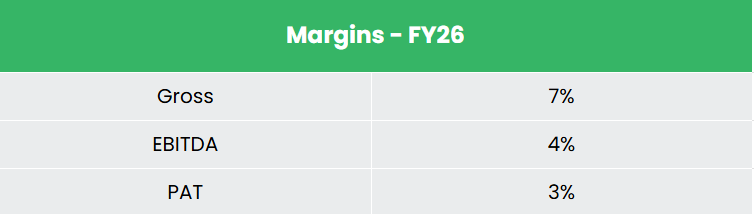
- FY26 – During FY26, Dixon generated revenue from operations of ₹48,873 crore, an increase of 26% over FY25, driven by the scale-up in mobiles. Adjusted EBITDA stood at ₹1,887 crore, up 23% YoY, with adjusted EBITDA margin at 3.9%. Adjusted net profit (after NCI) was ₹845 crore, up 20% YoY; reported net profit, including one-time fair-value and business-transfer gains, was ₹1,439 crore.
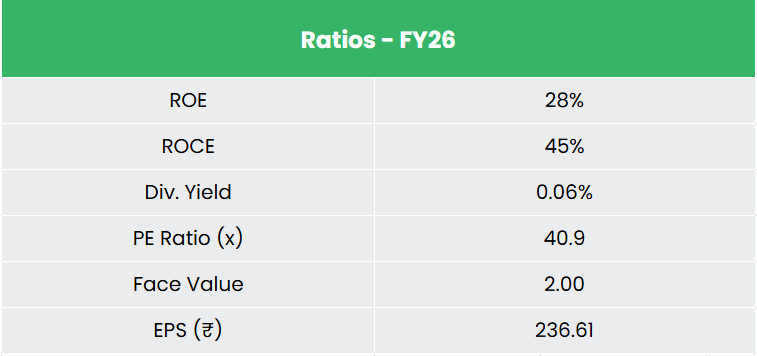
- Financial Performance – The 3-year revenue and net profit CAGR stand at 59% and 77%, respectively. The balance sheet is net-cash, debt-to-equity of about 0.2x, serviced by an interest coverage of ~16x. The 3-year average ROCE and ROE are around 37% and 34%, respectively.
Industry
India’s electronics manufacturing sector is among the fastest-growing pillars of the country’s manufacturing economy, propelled by rising incomes, low household penetration, premiumisation and a sustained “Make in India” push toward import substitution and export competitiveness. The appliances and consumer electronics market was valued at around US$ 75 billion in 2024 and is projected to nearly double to roughly US$ 149 billion by 2033, compounding at about 7.7%, while electronics hardware production reached about US$ 133.6 billion in 2025. Domestic value addition has risen sharply – mobile-phone production value climbed from ₹18,900 crore in FY14 to over ₹4.2 lakh crore, with around 99% of phones sold in India now made locally. The EMS/ODM opportunity is underpinned by PLI schemes for large-scale electronics, IT hardware and white goods, 100% FDI under the automatic route, and India’s ambition to become the world’s fourth-largest consumer-durables market by FY27.
Growth Drivers
- The current policy driver is the Electronics Components Manufacturing Scheme (ECMS) – A six-year scheme with a ₹40,000 crore outlay (FY27 Budget) that incentivises the components and sub-assemblies making up close to 90% of a smartphone’s bill of materials.
- India’s mobile-phone manufacturing has scaled from near-zero domestic sourcing to about 99%, with output value crossing ₹4.2 lakh crore, and the industry is moving decisively from import dependence to local manufacturing – a structural tailwind for outsourced manufacturers like Dixon as global and domestic brands localise production.
- 100% FDI under the automatic route for electronics hardware, cumulative electronic-goods FDI of ₹56,651.88 crore between April 2000 and December 2025, and rising discretionary incomes and premiumisation are expanding the addressable base; India is projected to become the world’s fourth-largest consumer-durables market by FY27, growing at an ~11% CAGR.
Peer Analysis
Competitors: Amber Enterprises India Ltd, Kaynes Technology India Ltd etc.
Compared with its peer set, Dixon combines the largest scale in the listed Indian EMS space with the strongest return profile and category-leading outsourced-manufacturing positions, generated on a net-cash balance sheet.

Outlook
Management remains confident of strong growth in FY27, led by a high double-digit sequential increase in smartphone volumes, supported by 12 – 15% higher average selling prices (ASPs). Beyond mobiles, the company expects double-digit volume growth in telecom & networking, 3x revenue growth in IT hardware, and is targeting ₹3,500 – 4,000 crore revenue from the IT hardware business while evaluating a JV to enter the fast-growing server and data centre infrastructure segment. Telecom & networking revenue is expected to increase from ₹5,000 crore in FY26 to ₹7,500 – 8,000 crore in FY27, while overall FY27 revenue guidance stands at ~₹56,000 crore (excluding the Vivo JV). Management also expects component businesses, particularly display modules and other backward integration initiatives, to emerge as key growth and margin drivers over FY27 – FY28. The expiry of the smartphone PLI scheme is expected to create a modest near-term margin headwind. However, management expects this to be largely offset by higher value addition through backward integration and benefits under the Electronics Component Manufacturing Scheme (ECMS).
Valuations
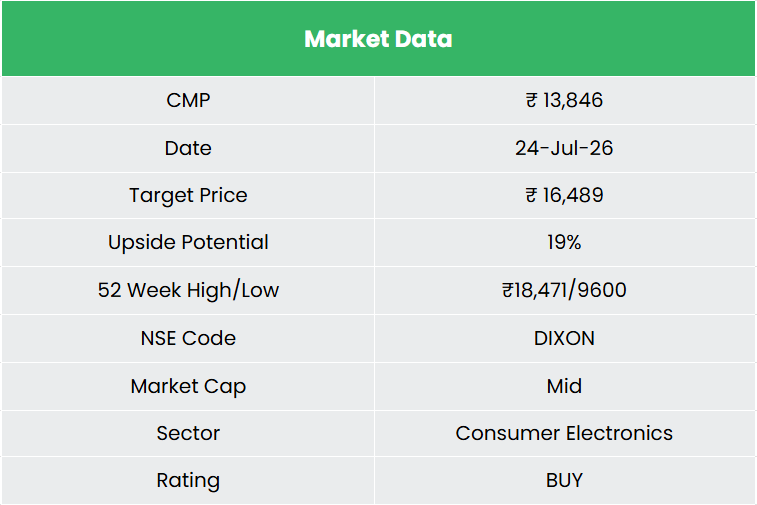
We believe strong execution, expanding backward integration and multiple growth levers position Dixon for sustained earnings growth. We recommend a BUY rating in the stock with the target price (TP) of ₹16,489, 51x FY28E EPS. We also encourage maintaining a stop-loss at 20% from the entry price to manage potential downside risk effectively.
SWOT Analysis
| Strength | Weakness |
|
|
| Opportunities | Threats |
|
|

Disclaimer: Investments in the securities market are subject to market risks, read all related documents carefully before investing. Securities quoted here are exemplary, not recommendatory. Please consult your financial advisor before investing. Please note that we do not guarantee any assured returns for the securities quoted here.
Research disclaimer: Investment in the securities market is subject to market risks. Read all the related documents carefully before investing. Registration granted by SEBI, and certification from NISM in no way guarantee the performance of the intermediary or provide any assurance of returns to investors.
For more details, please read the disclaimer.