KEI Industries Ltd. – India’s leading wire and cable manufacturer
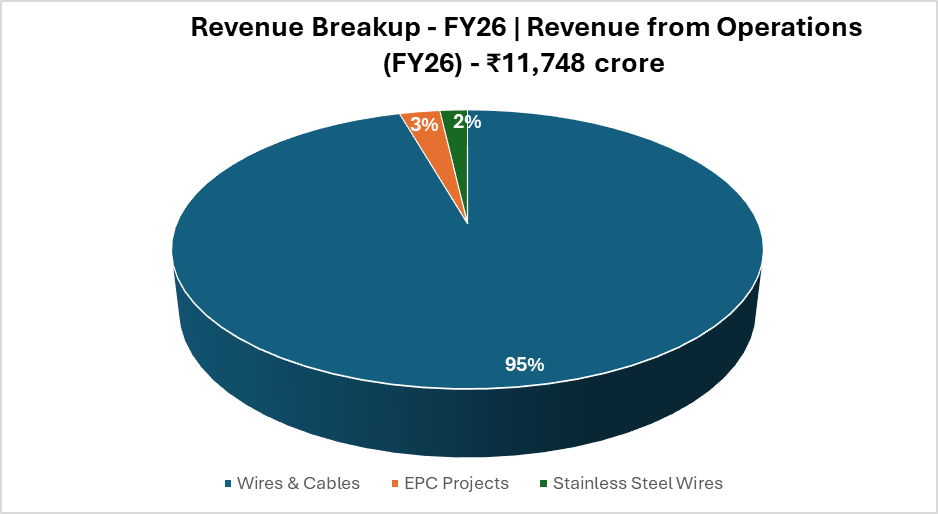
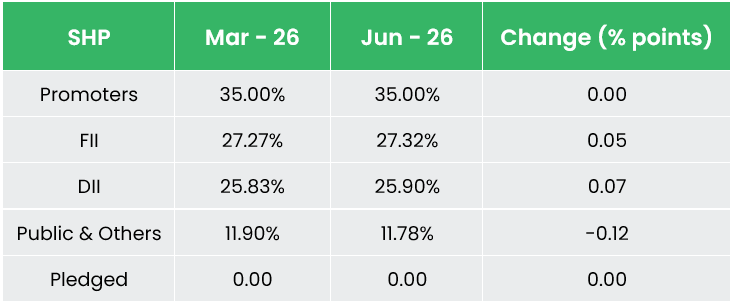
KEI Industries Limited, which began in 1968 as the partnership firm Krishna Electrical Industries and is headquartered in New Delhi, makes the widest range of wires and cables in India, from 1.1 kV up to 400 kV. The business is reported across three segments – Cables & Wires (95.88% of FY26 revenue), EPC Projects (2.65%) and Stainless Steel Wire (1.81%). EHV cables up to 400 kV are manufactured under a technical collaboration with Brugg Cables, and the company is among the few Indian manufacturers able to produce EHV cables beyond 220 kV. Ten plants are in operation – seven manufacturing units and three backward-integration units for PVC and XLPE compound – located at Rajasthan, Silvassa, and Gujarat. Installed capacity as on 31 March 2026 stood at 2,60,732 km of cables, 23,89,400 km of house and winding wire, 28,800 km of communication cable and 9,000 MT of stainless steel wire, operating at 83.87% utilisation in cables and 68.82% in house wire during FY26. The route to market spans 2,125 active dealers, over 20,000 retailers, an electrician network of more than 2,00,000, 36 branch offices, 26 depots and four overseas offices, with exports to more than 60 countries.
Products and Services
- Cables & Wires – EHV cables up to 400 kV, HT and LT power cables, specialty cables (control, instrumentation, solar, marine, EV charging, fire-survival), house wires, winding wires and communication cables; retail wires sell under the Homecab, ConFlame and BanPro brands.
- EPC Projects – Turnkey electrical projects including EHV cable laying and jointing, being run down in favour of higher-margin, lower-working-capital business.
- Stainless Steel Wires– Wire for industrial and engineering applications.
Subsidiaries: As of FY26, the company has no subsidiary and one associate, KEI Cables SA (Pty) Limited, South Africa (49% ownership interest).
Investment Rationale
- Sanand ramp-up anchors the next leg of growth – The ₹2,000 crore Sanand greenfield plant is the largest single driver of incremental revenue. Phase I, covering LT and MV cables, began commercial production in December 2025 and was running at 50% utilisation in Q1 FY27, with an electron-beam cable line becoming operational in the second quarter. Phase II, covering EHV cables and built around a 152-metre tower, is scheduled for commissioning by March 2027. Capex of ₹1,722 crore had been spent up to 30 June 2026, with the balance ₹300 crore due over the following six months. Management expects Sanand to contribute ₹1,500-2,000 crore of revenue in FY27 and to run at 70-75% utilisation next year, or roughly ₹4,000 crore. At full capacity the plant supports ₹6,000 crore of revenue, rising to about ₹7,000 crore within two years once balancing equipment is added, taking asset turns from 3x towards 4x. A further ₹700 crore LV and MV plant at Salarpur was announced in August 2026, of which ₹300-350 crore falls in FY27, and capex is guided at ₹600-700 crore annually for the next three to four years.
- Product and channel mix has reset the margin band higher – Operating margin reached 12.43% in Q1 FY27 against 9.96% a year earlier, clearing a hurdle the company had not crossed before, and management now guides to a sustained 11-12% band. Three things drive it. Product mix: EHV cables earn close to 15% operating margin against 10.5% for institutional LV and MV cables, 11% for retail and above 11% for exports, and EHV sales grew 47.7% YoY to ₹186 crore in the quarter. Channel mix: dealer and distributor sales grew 41.98% and now account for 59.09% of sales against 51.18% a year earlier, a channel that also absorbs less working capital. Operating leverage: total operating expenses fell to 12.34% of sales from 13.22%, since fixed costs do not scale with incremental volume. The low-margin, working-capital-heavy EPC business has also been run down to 1.36% of sales.
- EHV and exports open access to the transmission and global capex cycle – Domestic institutional EHV sales rose 82% to ₹559 crore in FY26 with existing capacity close to full utilisation, against a domestic EHV opportunity management sizes at over ₹3,000 crore. Sanand adds ₹1,300 crore of dedicated EHV capacity with HVDC-ready capability, taking EHV to roughly 9-10% of the capacity being added. Exports grew 45% to ₹1,833 crore in FY26, about 16% of sales across more than 60 countries, and are targeted at 17-18% in FY27 and 20% over the medium term. Q1 FY27 export wires and cables fell 7.29% YoY to ₹308 crore because Middle East shipments could not move during the regional conflict and US customs duty issues stalled dispatches; both markets have since reopened, albeit at higher freight cost. The pending order book of ₹4,292 crore at June 2026 – ₹2,400 crore domestic cable, ₹822 crore exports, ₹793 crore EHV and ₹271 crore EPC – supports the recovery.
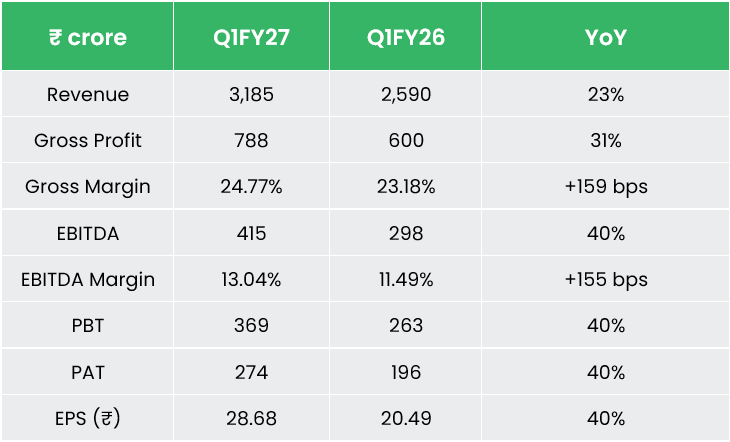
- Q1 FY27 – Revenue from operations grew 22.97% YoY to ₹3,185 crore, though it fell 8.37% sequentially off a seasonally strong Q4. Wires and cables, at 97.08% of sales, grew 24.4% to ₹3,092 crore, with domestic sales up 29.31% to ₹2,784 crore offsetting the export decline. EBITDA rose 39.57% to ₹415 crore and margin expanded 155 bps to 13.04%, while PAT grew 40.05% to ₹274 crore. Other income halved to ₹20 crore as QIP proceeds were deployed, and finance costs held at 0.55% of net sales. Inventory rose to ₹3,142 crore from ₹2,401 crore at March 2026, which management attributed to stocking the new Sanand plant and to ₹60-100 crore of finished goods being reversed. Capacity utilisation was 72% in cables, 61% in house wire, 91% in stainless steel wire and 45% in communication cable.
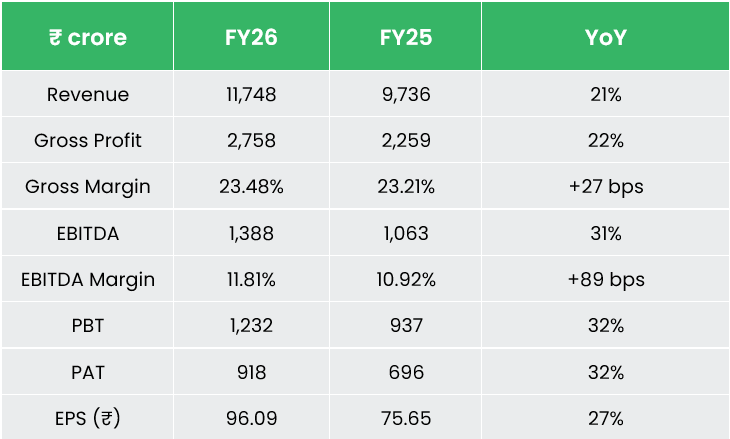
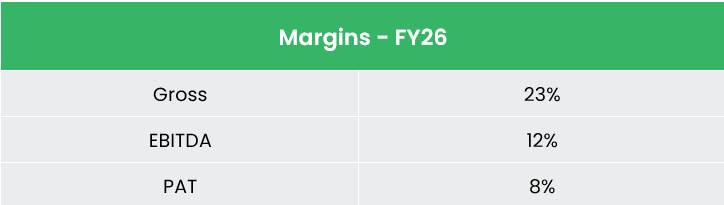
FY26 – Revenue grew 20.66% to ₹11,748 crore, led by wires and cables at ₹11,265 crore, up 22.32%. Growth was broad-based: retail dealer and distribution sales rose 25% to ₹6,349 crore and moved to 54% of sales from 52%, house wire sales grew about 32%, exports rose 45% to ₹1,833 crore and domestic institutional sales grew to ₹3,614 crore. EPC excluding cables fell to ₹311 crore from ₹343 crore as the company continued to step back from the segment. EBITDA rose 30.56% to ₹1,388 crore with margin at 11.81%, and operating margin excluding other income improved to 10.46% from 10.18%. PAT grew 31.88% to ₹918 crore. Capex was ₹1,254 crore, largely Sanand, against operating cash flow of ₹840 crore.
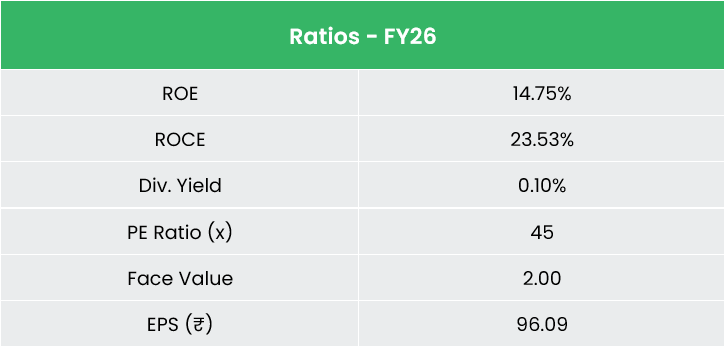
Financial Performance – The 3-year revenue and net profit CAGRs stand at around 19% and 24% respectively for the FY23-26 period. The balance sheet is effectively debt-free: gross debt of ₹204 crore against cash and bank balances of ₹1,054 crore at June 2026 leaves net cash of ₹850 crore, or ₹285 crore after acceptances of ₹565 crore, with a debt-equity ratio of 0.03x and interest coverage of 20.22x in FY26. On the company’s reported basis, ROCE has averaged about 25% over FY24-26 and stood at 23.53% in FY26, while ROE was 14.75% against 15.59% in FY25, the decline reflecting the ₹2,000 crore QIP raised in November 2024. Management notes that returns are currently held back by a decision to buy metal on cash, which has cut creditor days from about 3.5 months to under 1.5 months. FY26 operating cash flow was ₹840 crore against capex of ₹1,254 crore.
Industry
India is the world’s third-largest producer and consumer of electricity, with installed capacity of 542.36 GW as of May 2026, roughly 54% of it non-fossil. Generation reached 1,840.11 billion units in FY26 and peak demand met touched a record 241.21 GW in December 2025, with the CEA estimating the requirement will reach 817 GW by 2030. Renewable capacity has tripled since March 2014 to 225.61 GW, against a 500 GW non-fossil target for 2030. The build-out is matched by committed investment: ₹42,00,000 crore (US$ 496.69 billion) by 2032 to upgrade the power sector, of which ₹9,15,920 crore (US$ 107 billion) is transmission, while Motilal Oswal sizes the decade-long opportunity at ₹40,00,000 crore (US$ 461.95 billion).
Growth Drivers
- Transmission and distribution build-out: India plans to invest ₹9,15,920 crore (US$ 107 billion) in transmission lines by 2032, with substation capacity reaching 624,332 MVA by FY2029-30, up 29.31% over March 2022. A proposed PLI-like scheme for transmission equipment, covering 190,000 circuit kilometres and 1,270 GVA, could draw over ₹9,00,000 crore (US$ 104.54 billion) by 2035. New inter-state schemes will evacuate 9 GW of renewable power from Rajasthan and Karnataka.
- Renewable capacity addition and storage: Renewable capacity reached 225.61 GW in May 2026, or 41.60% of installed capacity, and the CEA expects the renewable share of generation to rise from 18% to 44% by 2029-30 as thermal falls from 78% to 52%. Fifty-five solar parks carry a sanctioned capacity of nearly 40 GW, offshore wind targets 30 GW by 2030, and storage should attract ₹4,79,000 crore (US$ 56.07 billion) by 2032.
- Distribution modernisation and demand growth: India had installed 4.76 crore smart meters under the RDSS by December 2025, backed by a ₹16,021 crore (US$ 1.86 billion) allocation. PM Surya Ghar targets 30 GW of rooftop solar across one crore households by March 2027. Industry, at 41.8% of FY24 electricity use, remains the largest demand driver, and peak demand hit a record 2,41,213 MW in December 2025.
Peer Analysis
The company’s peer set includes Polycab India Ltd, Finolex Cables Ltd, etc.
KEI ranks second in the peer set by market capitalisation, behind Polycab, and is the only company in it with EHV capability up to 400 kV, a qualification barrier materially harder than the LT and house-wire markets where most peers compete. It nonetheless screens with lower return ratios than Polycab, and the gap is largely structural rather than operational: ₹1,722 crore has been sunk into Sanand against a plant that contributed only a fraction of its ₹6,000 crore revenue potential during the period, unutilised QIP proceeds of ₹303 crore still sit on the balance sheet, and management buys metal on cash rather than credit, which has cut creditor days from about 3.5 months to under 1.5 months and, on its own estimate, costs roughly four percentage points of ROCE. Finolex screens lowest on both growth and returns, consistent with its narrower LT and house-wire positioning.

Outlook
Management has guided to revenue growth of more than 25% in FY27 and a CAGR above 20% over the next two to three years, with a stated preference for disciplined capital allocation over matching industry growth of 30-35%. The operating margin band is guided at 11-12% now that the long-standing 11% hurdle has been cleared, on a pure operating basis excluding other income. Exports are targeted at 17-18% of revenue in FY27 against 16% in FY26 and 20% over the medium term, helped by Middle East shipments resuming and the US market reopening, though at higher freight cost. Sanand should contribute ₹1,500-2,000 crore in FY27, reach 70-75% utilisation next year and support about ₹7,000 crore of revenue within two years once balancing equipment is added, with Phase II EHV commissioning due by March 2027. Capex stays at ₹600-700 crore a year, funded from internal accruals with no new debt planned for Sanand, and the ₹700 crore Salarpur LV and MV plant will take two years to build. The company has reiterated a ₹25,000 crore revenue target for FY29-30. Two items work the other way: other income will not repeat at FY26 levels as QIP proceeds are consumed, and ROCE is likely to stay in the 23-24% range while the capex cycle runs.
Valuations
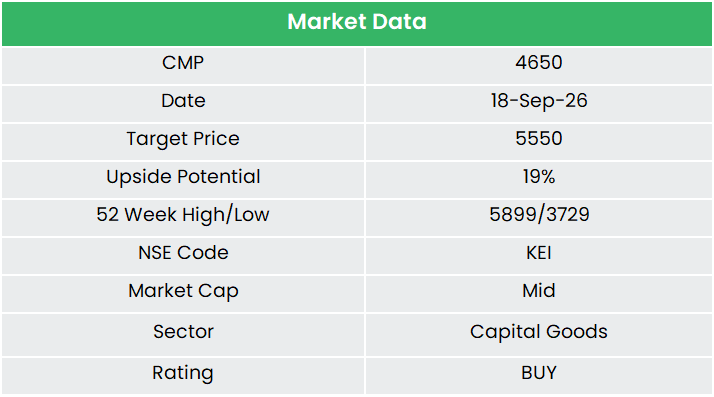
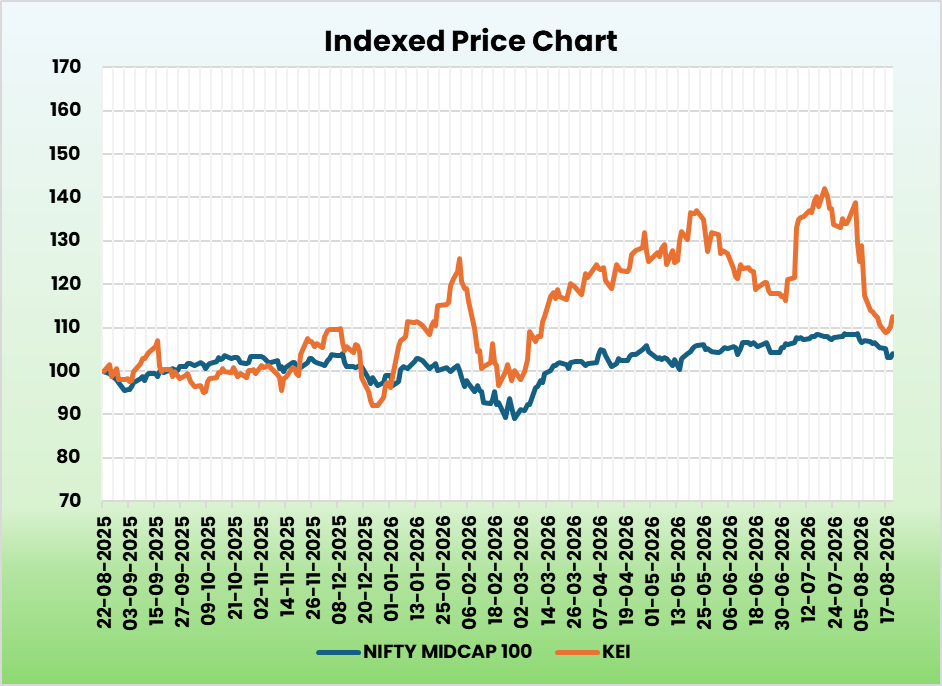
Given EHV capability up to 400 kV in a market where transmission capex is committed through 2032, a capex pipeline that adds close to ₹7,000 crore of revenue potential at Sanand alone, and a mix shift towards retail, EHV and exports that has moved the operating margin band from below 11% to 11-12%, we expect KEI Industries Ltd to compound earnings ahead of revenue over the next two to three years. We recommend a BUY rating in the stock with the target price (TP) of ₹ 5,550, 37x FY28E EPS. We also encourage maintaining a stop-loss at 20% from the entry price to manage potential downside risk effectively.
SWOT Analysis
| Strength | Weakness |
|
|
| Opportunities | Threats |
|
|

Disclaimer: Investments in the securities market are subject to market risks, read all related documents carefully before investing. Securities quoted here are exemplary, not recommendatory. Please consult your financial advisor before investing. Please note that we do not guarantee any assured returns for the securities quoted here.
Research disclaimer: Investment in the securities market is subject to market risks. Read all the related documents carefully before investing. Registration granted by SEBI, and certification from NISM in no way guarantee the performance of the intermediary or provide any assurance of returns to investors.
For more details, please read the disclaimer.