
Planning is crucial as none of us plan to fail but most of us fail to plan. Thus, once we have assessed our financial status we can proceed to the next step of building a financial plan to achieve our goals. Otherwise most of our goals would be distant dreams.
An effective financial plan consists of the following elements:
- Clear measurable goals: To retire at 50 with Rs 1 Crore is clear and measurable than " to retire early with lots of money " which is vague and distant.
- Co-related financial decisions: There is no isolated financial decision as each financial decision affects other goals and overall plan. An early retirement decision may mean that you may have to postpone buying a car or shifting to a smaller home. Bearing this in our mind frees us from wanting to achieve all goals rather than the goals that really matter.
- Being realistic: Remember that our financial situation is unique and brought about by our own set of circumstance. Hence being realistic helps a lot. For example, you can afford a house that is around three years your average take home salary. So it is not possible for you to buy a posh bungalow unless it costs around three times your annual income. The biggest threat to achieving our goals is being unrealistic both in setting goals and in pursuing it.
Once these basic elements are taken into account it becomes much easier to proceed with the plan. First we need the relevant financial data for the goals such as:
- Buying a home - Cost and the EMI.
- Children's education or marriage - Fees to be paid or marriage cost.
- Retirement planning - Money we need monthly post retirement to maintain a decent quality of life.
- Vacation - Travel cost.
All these goals need to have a time frame. Let us assume that you wish to buy a house by 2013 and the current cost is Rs. 25 lakhs. Let us assume that the prices are likely to increase by 10% per annum. Then the same house would cost Rs. 36 lakhs in 2013. So you should first aim to save and invest enough to generate Rs. 36 lakhs by 2013. Even if you can save only Rs. 12 lakhs by 2013 then you need to go for Rs. 24 lakhs loan. This reduces the interest burden which otherwise would have been higher if you had taken a loan for the entire sum of Rs 36 lakhs. This also means that savings on interest can be channeled towards the next or other goals.
Thus, you need to save more to minimise the amount you need to borrow from the bank. Let us assume that you have saved Rs. 6 lakhs till now and can save Rs. 2 lakhs per annum till 2013. Here is the financial plan for this amount:
Money available: Rs 6 lakhs
Savings per annum: Rs 2 lakhs per annum for 5 years
Let us assume that you invest the money and it earns 10% every year. Then by 2013 you will have an amount of Rs 23 lakhs to buy that house and would need Rs 13 lakhs loan. You need to bear in mind that this money needs to be very safe and can not be invested in any assets that has a element of risk attached. So the only option left is fixed deposit in a safe place such as a bank.
If on the other hand, we have a goal that is far off, say retirement 20 years later then we can and should take risk with that money so that it earns higher returns to combat higher inflation in future.
The process of answering the following questions before investing money is known as asset allocation.
- What is the money meant for?
- When is it required?
- What is the risk that can be taken with that money?
The available investment avenues are:
- Equity related (Shares, Equity Mutual Funds).
- Debt related (Fixed deposit, Income Funds, Bonds).
- Hybrid (Has both equity and debt investments in various percentages such as Balanced Fund, Monthly income fund, etc.).
- Cash Related (Short term investments for a period of less then one year meant such as SB account balance, short term FDs, short term income funds and liquid/money market funds).
- Real Estate (Plots, House, RE investment Funds).
- Commodities such as gold.
Risk Vs Reward Pyramid
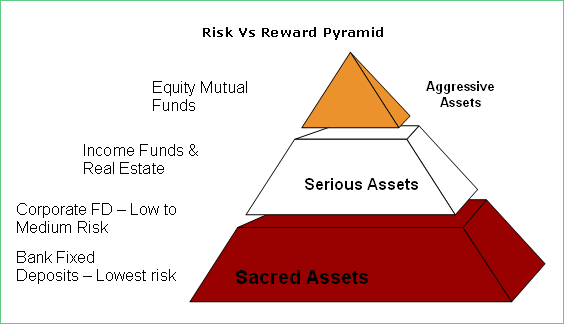
Financial plan puts things into perspective by giving a number (Amount needed) for the future dream. In the above discussed example of retirement planning one can invest a portion in equity funds and rest in debt related investments for the long term. Equity is likely to be ruled out in the example where you wish to buy a home. This is because money in sacred and needed back as it is for the purpose of buying a home. In this case your investments are likely to be restricted to Bank FDs, Income Funds etc.
Thus longer the time frame allows a person to take more risk as markets tend to grow along with the country's GDP in the long term. However, in the short term they may be very risky and hence caution is advised.
Equity market, though they pose a higher level of risk in the short term have given spectacular returns in the past over the long term. For example, equity returns of mutual funds over the last decade has averaged close to 15% annually making them very attractive but they are very volatile and show very sharp up or down moves over a 1-5 year periods, Hence equity assets are better suited for the long term growth and long term goals such as retirement or children's education than short term goals such as buying a house in three years or a vacation in two years.
In the same time period income/bond funds have averaged about eight percentage with less volatility and are useful for investing in the short term.
So the risk and reward is historically in favor of equities in the long term and debt in the short term. This clearly shows the relation between risk and reward. Longer the time frame helps you take greater risk which is likely to yield higher returns. Short time frame yields less risk and lesser returns. Since some of our goals are short term and some long term we need to have a healthy mix of both safe and risky assets to meet our goals. Asset allocation is the cornerstone of a good Financial Planning.


